



The blade gets most of the attention, but the handle is the part of a knife you actually hold. It decides how the knife grips when your hands are wet, cold or gloved, how much it weighs in the pocket, how it wears over the years and how it looks on the day you buy it. This guide covers the handle materials you will meet on modern knives, from G10 and carbon fiber to aluminum, titanium, micarta, wood and molded plastics, what each does well and badly, what TEKTO® uses on which knife and why, and how to look after each one.
The Short Version
G10 is the best all-round handle material for a working knife: light, tough, unaffected by water and easy to texture. Carbon fiber and forged carbon are lighter and stiffer and look the part, at a higher price. Aluminum is the right material for a slim, rigid metal handle, which is why it houses nearly every out-the-front automatic, including ours. Titanium is aluminum's premium cousin, stronger and more expensive. Micarta and wood are the warm, traditional choices, and molded plastics like FRN are the light, inexpensive ones. If you want one answer for a knife that will be used hard, pick G10.
What a Handle Has to Do
A good handle does five jobs at once. It has to grip, dry or wet, bare-handed or in gloves, without being so rough it shreds a pocket. It has to be stiff enough to keep a folder's pivot and lock aligned and an automatic's blade channel true. It has to be light enough to carry every day. It has to survive drops, sweat, solvents, sunlight and years of being sat on. And it has to look like something you want to carry. No material wins every one of those, which is why the choice is always a trade. Our folding knife anatomy guide shows how the handle fits with the liners, the pivot and the lock.
G10
G10 is a laminate of woven fiberglass cloth soaked in epoxy resin and pressed under heat into a dense, hard sheet. It is the same family of material used for circuit boards, and it was adopted by knifemakers because it is nearly indestructible in a pocket. It does not absorb water, oil or blood, so it does not swell, crack in the cold or get slick when wet. It is lighter than metal, stiff enough to carry a lock, and it takes machined texture well, from a fine stipple to deep grooves. It comes in almost any color and can be layered in contrasting colors for patterned looks. Its only real weaknesses are that it is a little heavier than carbon fiber and that a very aggressive texture can wear the inside of a pocket.
G10 is our workhorse. It is on the F1 Alpha, the F2 Bravo, the F3 Charlie, the A3 Delta and the X1 Atlas, and it is the inlay on the F4 Echo. The Damascus G10 option on the F2 and F3 is G10 made from contrasting layers, so the machined scale shows a flowing pattern. It is a handle material, not Damascus steel, and our Damascus steel guide explains the difference.
Carbon Fiber and Forged Carbon
Carbon fiber is made from bundles of very fine carbon filaments, woven into cloth, laid up in layers and set in resin. It is lighter than G10 and stiffer for its weight, which is why it shows up on race cars and bicycle frames, and the woven pattern under a clear finish has a look nothing else has. The trade-offs are cost and a little fragility at the edges: a hard knock on a corner can chip or crack it where G10 would shrug it off, and a polished finish can be slick in a wet hand unless it is textured.
Forged carbon is carbon fiber cut into short strands and pressed into shape with resin instead of being woven. The strands land in random directions, which gives a marbled surface that is different on every knife and strength that does not depend on the direction of a weave. TEKTO uses carbon fiber on the F1 Alpha and on the carbon fiber edition of the A2 Badger, and forged carbon on the F1 Alpha, the F2 Bravo, the F3 Charlie, the A3 Delta and the F2 x EOTECH. The F2 Bravo's Forged Ember style is forged carbon shot through with red.
Aluminum
Aluminum is the lightest common metal for a knife handle, and the alloy most knives use, 6061-T6, is strong, stiff and easy to machine to tight tolerances. It is anodized, a process that builds a hard oxide layer on the surface and takes color, so it can be black, OD green, desert, bronze or nearly anything else. It does not rust. Its downsides are that it feels cold in winter, it can dent or scratch through the anodizing to bare silver metal under hard use, and a smooth aluminum handle needs texture or grooves to grip well.
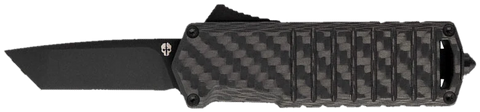
Aluminum is the right material for an out-the-front automatic, because the handle is also the housing for the blade's track and spring, and it has to stay perfectly straight and rigid. TEKTO's out-the-front automatics are built on 6061-T6 aluminum handles: the A2 Badger in black, desert or OD green, the A5 Spry and A5 Spry Mini, and the A7 Zastava, which sets wood inlays into its scales. The A2 Badger also comes in a carbon fiber edition. The F4 Echo uses an aluminum frame with G10 inlays, which gives a folder the slim, rigid feel of a metal handle with the grip of G10.
Titanium and Stainless Steel
Titanium is the premium metal handle. The common grade, 6Al-4V, is far stronger than aluminum and much lighter than steel, it never corrodes, and it can be anodized in colors or left with a stonewashed gray finish. It is the classic material for frame-lock folders, where a section of the handle itself springs behind the blade to lock it. It costs more to buy and much more to machine, it scratches easily, and it can feel slippery without texture.
Stainless steel handles are strong and inexpensive, but they are heavy for their size and slick in the hand, which is why they mostly show up on small gentleman's knives, frame locks at lower prices and as the liners inside other handles. Many folders with G10 or carbon fiber scales have thin steel liners inside that stiffen the frame, and on a liner lock knife like the F1 Alpha or F2 Bravo, part of that liner is the lock.
Micarta
Micarta is a laminate like G10, but made from layers of linen, canvas or paper set in phenolic resin instead of fiberglass in epoxy. It feels warmer and softer than G10, and it gets grippier, not slicker, when it is wet, which makes it a favorite on bushcraft and fixed blades. Over the years it soaks up a little oil from the hand and darkens into a patina that many owners love. It is not quite as tough as G10, it can stain, and the canvas grades show their weave as they wear. A light sanding refreshes it.
Wood and Other Natural Materials
Wood is the oldest handle material and still the warmest. Every piece is different, it feels good in the hand, and it ages with the knife. Raw wood moves with moisture, so it can swell, shrink or crack, which is why many modern knives use stabilized wood that has been soaked with resin under vacuum to lock the grain. Wood needs a little more care than synthetic materials and does not like being left wet. Bone, stag, horn and mother of pearl fall in the same family: beautiful, traditional and best on knives that do lighter work.
The A7 Zastava is our wood knife. Its aluminum handle carries wood inlays in Serbian red, black or American walnut, so the frame does the structural work and the wood gives the warmth, and because the grain varies from piece to piece, no two are the same.
FRN, Zytel and Rubber
FRN, fiberglass reinforced nylon, is a plastic filled with glass fibers and injection molded into shape. Zytel is a brand name for a similar glass-filled nylon. It is light, tough, flexible enough not to crack, inexpensive, and the texture is molded right in, which is why it is on many of the best-value folders made. It can feel hollow or flexy in a large knife and does not have the finish of a machined handle. Rubber and other soft overmolds, common on fixed blades and kitchen knives, give the best grip of all when wet and with gloves, at the cost of bulk and a surface that can tear or wear over time.
What TEKTO Uses and Why
Our choice follows the knife. The out-the-front automatics need a rigid, precisely machined housing for the blade's track, so they are built on 6061-T6 aluminum. The folders get G10, carbon fiber and forged carbon scales, because those materials grip well, weigh little and stand up to work, and they take the styles people ask for, from plain black G10 to forged carbon and Damascus G10. The F4 Echo combines an aluminum frame with G10 inlays. The A3 Delta, a side-opening automatic built for gloved hands, uses a big G10 or forged carbon handle. And the X1 Atlas, a full-tang fixed blade for the field, uses G10 because it grips wet and does not care about blood, mud or rain. Our product guides for the F1 Alpha, F3 Charlie, A5 Spry and X1 Atlas go into each handle in detail.
Texture, Shape and Grip
Material is only half of grip. The other half is shape and texture. A handle that swells slightly in the middle fills the palm, a finger choil behind the blade lets you choke up for detail work, and jimping on the spine gives the thumb a place to push. Texture can be machined into G10 and aluminum, molded into FRN, or left to the material itself, as with micarta. More texture grips better and wears pockets faster, so most good handles put the aggressive texture where the hand needs it and keep the edges smooth. Size matters too: a handle that is too short leaves your little finger hanging, which is why our folders under $200 page compares the whole knife, not just the blade.
Caring for Each Material
G10, carbon fiber and forged carbon need almost nothing: wash them with warm water and a little dish soap, scrub the texture with a soft brush, and dry the knife. Avoid harsh solvents on carbon fiber, which can dull its finish. Aluminum and titanium clean the same way, and a scratch through the anodizing on aluminum is cosmetic, since the metal underneath will not rust. Micarta washes with soap and water and can be sanded lightly to bring back its texture. Wood wants to be wiped rather than soaked, and a little wax or oil now and then keeps it from drying out. FRN and rubber need only soap and water, and should be kept away from strong solvents.
Whatever the handle, check the screws now and then and keep lint out of the pivot. On an out-the-front automatic, do not open the handle yourself, since the spring and track are set to tight tolerances. If one ever needs attention inside, send it to us. Our folding knife maintenance guide and OTF cleaning guide cover the full routine, and the finishes and coatings guide covers the blade side of the knife.
Four Handles, Four Materials
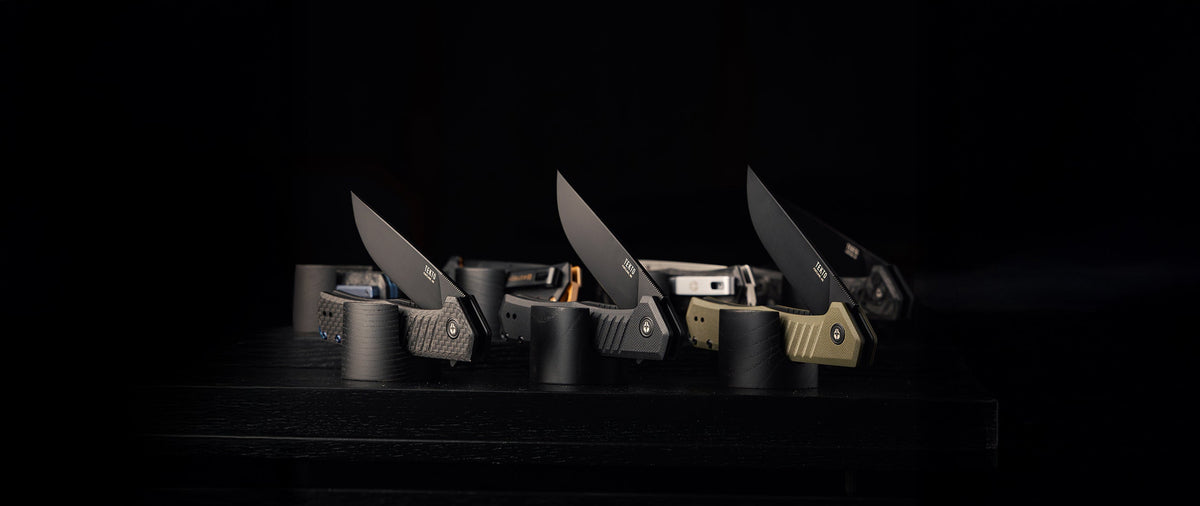
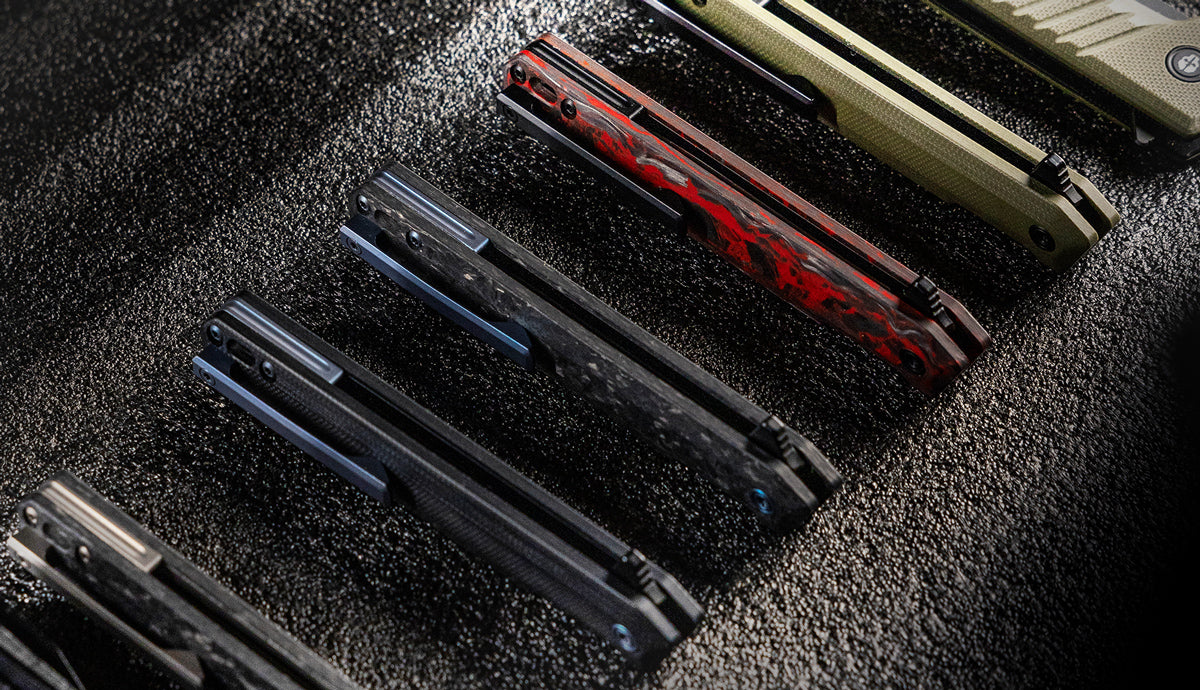
G10 on the F3 Charlie, forged carbon and Forged Ember on the F2 Bravo, machined aluminum on the A5 Spry and wood inlays on the A7 Zastava.
-
-
-
-

LOW ON STOCK


People Are Asking
What is the best knife handle material?
For a working knife, G10. It is light, tough, unaffected by water and easy to texture for grip. Carbon fiber is lighter and stiffer at a higher price, aluminum is best for slim metal handles like an OTF's, and micarta and wood are the warm, traditional choices.
Is G10 better than carbon fiber?
G10 is tougher and grips better, especially when textured, and it costs less. Carbon fiber is lighter and stiffer for its weight and has a look many people prefer, but it can chip at the edges under a hard knock. For hard use, G10. For the lightest, best-looking folder, carbon fiber or forged carbon.
What is forged carbon?
Carbon fiber cut into short strands and pressed into shape with resin instead of being woven. The strands land in random directions, which gives a marbled pattern that is different on every handle. TEKTO uses it on the F1 Alpha, F2 Bravo, F3 Charlie, A3 Delta and F2 x EOTECH.
Why do OTF knives have aluminum handles?
An out-the-front knife's handle is also the housing for its blade track and spring, so it has to be rigid and machined to tight tolerances. 6061-T6 aluminum is light, stiff, easy to machine precisely and does not rust, which is why TEKTO's OTFs use it.
Is Damascus G10 made of steel?
No. Damascus G10 is G10 made from contrasting layers, machined so the scale shows a flowing pattern like Damascus steel. It is a handle material on the F2 Bravo and F3 Charlie, and it needs no more care than any other G10.
How do I clean a knife handle?
Warm water, a little dish soap and a soft brush clean G10, carbon fiber, aluminum, titanium, micarta and FRN. Dry the knife afterward. Wood should be wiped rather than soaked and given a little wax or oil now and then. Do not open an OTF's handle yourself.