The Difference in One Sentence
On a drop point, the spine runs in an unbroken convex curve from the handle down to the tip, so the point sits below the spine and carries plenty of steel behind it. On a clip point, the spine runs straight for most of its length and then is cut away, or clipped, in a straight or concave line to the tip, which lands the point low, thin and sharp. Same blade, two different ways of reaching the end of it.
Tip Strength
This is the trade the whole comparison turns on. A drop point keeps the full thickness of the spine almost to the tip, so the point is backed by a wedge of steel and shrugs off twisting, prying at the tip and the occasional drop onto concrete. The clip removes that steel. The clip point's tip is finer, which is what makes it pierce so well, and it is the part of the knife most likely to snap or roll if it is levered sideways in something hard. If a blade is going to be used as a tool first, the drop point is the safer bet.
Piercing and Detail Work
The clip point wins here. The narrowed tip enters material with less resistance, and because the point sits close to the centerline of the handle, it goes where you aim it. That is why the clip point rules on Bowie knives, on traditional slipjoints, and on knives used for fine work: starting a cut in cardboard, opening a seam, deboning, picking out a splinter. A drop point can do all of it, with slightly more effort at the moment the tip goes in.
Belly and Slicing
Belly is the curved section of edge near the tip, and it is where slicing happens. A drop point generally carries more of it, because the lowered point pulls the edge up into a longer sweep. More belly means a longer cutting stroke on rope, cardboard, food and hide, and a tip that is less likely to catch and puncture what you are slicing, which is why skinning knives are nearly always drop points. A clip point has belly too, just less of it, with a longer straight run of edge behind.
Control
Both shapes put the point low enough to see and steer. The clip point's finer tip gives slightly more precision. The drop point's broader tip gives slightly more feedback through the handle when you push through something. In the hand the difference is small. In the material it is noticeable: the clip point feels like a scalpel, the drop point like a chisel with a sharp edge.
Sharpening and Upkeep
A drop point is the easier shape to sharpen because the edge is one continuous curve: you follow the belly around to the tip in a single motion. A clip point has a straight section, a belly and a fine tip, and the tip is easy to round over if you lift the spine at the end of the stroke. A false edge on the clip, where the clipped spine is ground to a bevel, is a sharpening job of its own and is sharpened on some knives and left blunt on others. Neither shape needs more frequent sharpening. The steel decides that. Our sharpening guide covers the method for both.
Which One Should You Carry?
For a knife that opens boxes, cuts cord, trims and scrapes, and gets used at the tip, the drop point. Its strength covers the way most people actually use a pocket knife, which is harder than they think and rarely for fine piercing. For a knife that will do detail work, dress game with care, or simply be enjoyed for its lines, the clip point, carried with the knowledge that the tip is the delicate part. If you are choosing one knife for everything, choose the drop point and buy the clip point second.
| Drop point | Clip point | |
|---|---|---|
| Spine | Convex curve to the tip | Straight, then clipped to the tip |
| Tip | Thick, strong, lowered | Thin, sharp, lowered |
| Piercing | Good | Excellent |
| Belly for slicing | More | Less |
| Tip strength | Excellent | Fair |
| Control | Steady | Precise |
| Sharpening | One continuous curve | Straight, belly and a fine tip |
| Classic examples | Hunting knives, most modern folders | Bowie knives, traditional slipjoints |
| Best for | Everyday carry, work, hunting, camp | Detail work, deboning, collecting |
Why TEKTO Builds Drop Points
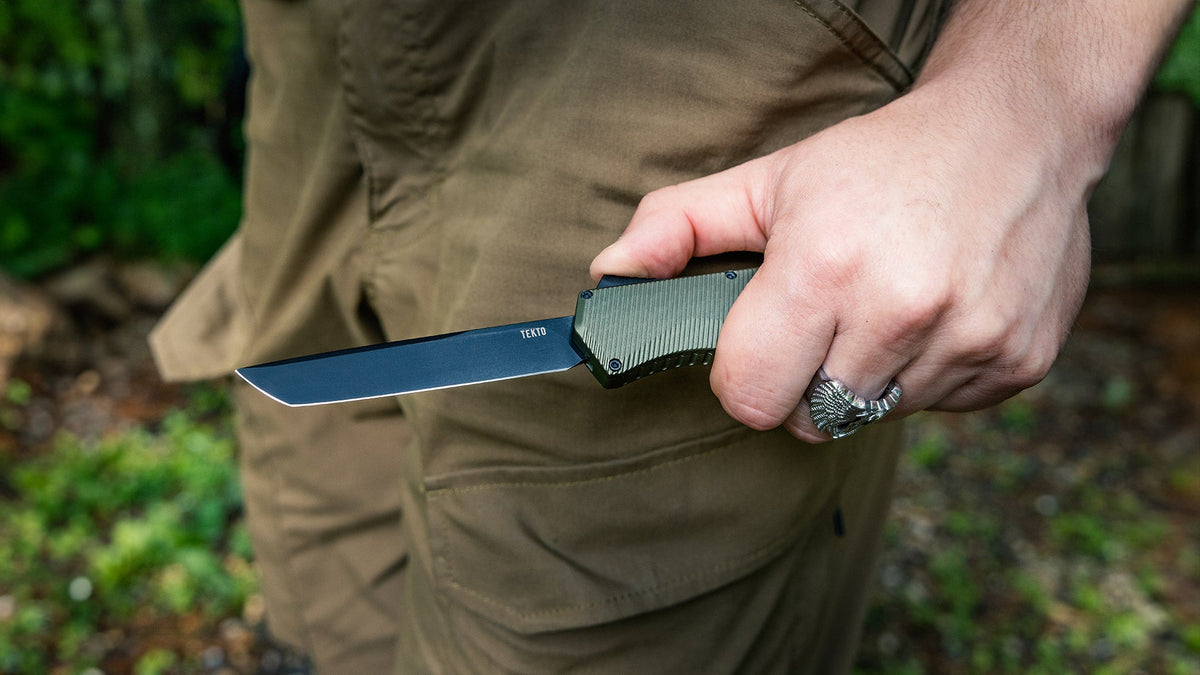
The drop point is the most common blade in the TEKTO range, and there is no clip point in it. That is a decision, not an oversight: a TEKTO is built as a working knife, the tip is the part of a working knife that fails first, and the drop point is the shape that keeps the tip alive. The F2 Bravo and F3 Charlie folders, the A3 Delta automatic in both sizes, the A5 Spry and A5 Spry Mini OTFs in their Drop Point blade, and the X1 Atlas fixed blade all carry it. If you want a finer point from TEKTO, the Tanto blade on the A2 Badger, A5 Spry and A5 Spry Mini gives a reinforced one, the A7 Zastava's Spear Point sits between the two, and the F1 Alpha's modified straight back puts the point high for a long, flat cutting edge.
Drop Points, Four Ways
A slim folder, a full-size folder, an automatic and the fixed blade, all on the shape this guide recommends.


People Are Asking
Is a clip point or a drop point better?
For most people, the drop point: a stronger tip, more belly for slicing, and easier sharpening, which covers everyday carry, work and hunting. The clip point is better at piercing and fine work. Neither is wrong. The drop point is harder to break.
What is a clip point blade good for?
Piercing and detail work. The clipped spine leaves a thin, sharp tip that enters material easily and goes exactly where you aim it, which is why it is the classic shape on Bowie knives and traditional slipjoints and a favorite for deboning and fine cutting.
Are drop point knives good?
Yes, and they are the most common shape on modern folders and hunting knives for a reason: the tip is strong, the belly is long, and the shape sharpens in one continuous stroke. If a knife is going to be used hard, the drop point is the shape that survives it.
What is a drop point knife used for?
Everything a pocket knife does: boxes, cord, food, camp chores, and skinning and dressing game, where the lowered, rounded tip is less likely to puncture what you are cutting. It is the default shape for everyday carry.
Which is better for self-defense, clip point or drop point?
A knife is a cutting tool first, and this guide is about carrying one for work. On the geometry alone, the clip point pierces more easily and the drop point is less likely to break. The far bigger factor is a knife you can open and control, and local law. See our state knife law guides before you carry any blade for that reason.
Drop point vs tanto: what is the difference?
A tanto replaces the belly with a second straight edge meeting the main edge at an angle, which puts a thick, reinforced point on the blade at the cost of slicing curve. Our tanto guide covers it. The short version is drop point for slicing, tanto for the strongest possible tip.
What is a spear point?
A symmetric blade where the spine and the edge curve equally to a point on the centerline, like a drop point mirrored. It pierces well and keeps a stronger tip than a clip point. The A7 Zastava's single-edge option is a spear point.
Does TEKTO make a clip point knife?
No. The range is built around the drop point for tip strength, with tanto, reverse tanto, spear point and straight-back blades for people who want a different point. The drop point models are the F2 Bravo, F3 Charlie, A3 Delta and A3 Delta Mini, the A5 Spry and A5 Spry Mini in Drop Point, and the X1 Atlas.