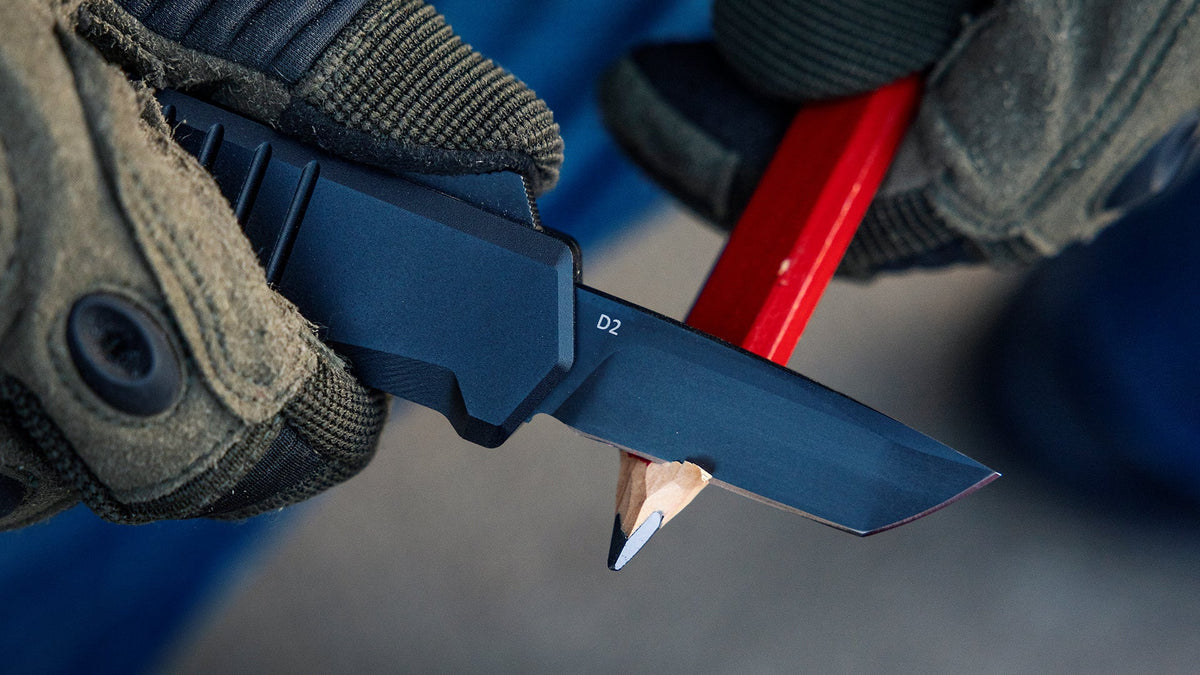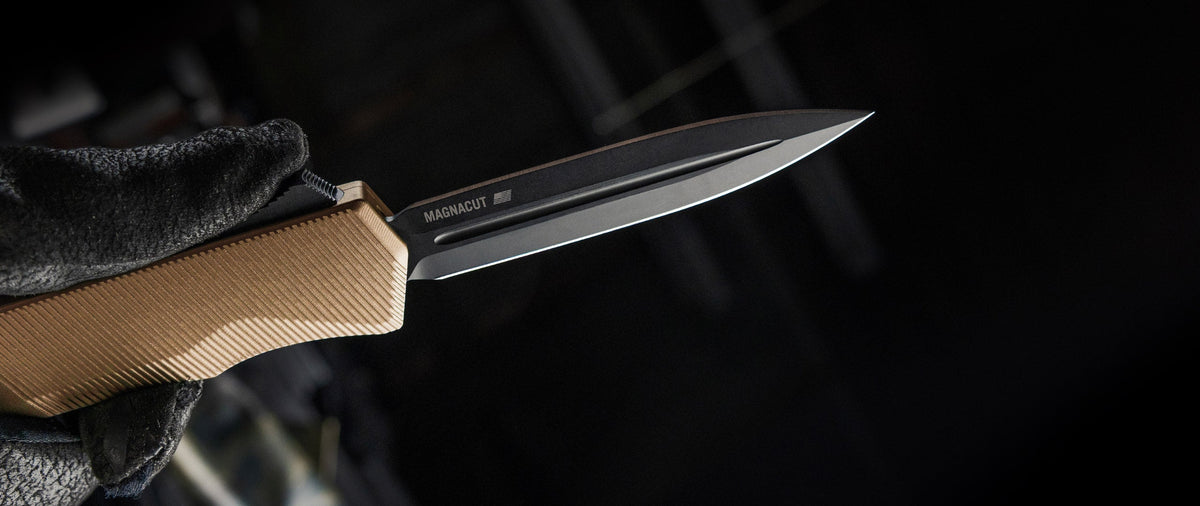
MagnaCut is the steel TEKTO runs on the X1 Atlas fixed blade and the A5 Spry Bronze Edition: a powder-metallurgy stainless engineered to close the gap between edge retention, toughness and corrosion resistance, three properties that have historically forced a trade-off in blade steel. For first responders and anyone who works a knife hard, that trade-off has consequences: a blade that holds an edge but chips on contact, or resists rust but dulls fast, fails when it matters.
The Trade-Off: Why Edge Retention Usually Costs Toughness
Blade steel performance comes down to three competing properties:
- Edge retention: how long the blade holds a working edge under load.
- Toughness: resistance to chipping, cracking or edge rollover on impact.
- Corrosion resistance: resistance to rust from moisture, blood and salt.
Raising carbide content improves wear resistance but reduces toughness. Raising chromium for corrosion resistance often locks the chromium up in carbides, costing both toughness and consistent grindability. Most legacy steels force a choice of two out of three. MagnaCut was designed specifically to reduce that compromise.
Origin: Who Developed MagnaCut
MagnaCut was developed by metallurgist Larrin Thomas, known for his research at Knife Steel Nerds. Unlike many blade steels adapted from industrial or tooling uses, MagnaCut was modeled and tested for knife performance before it went into production. It is made by powder metallurgy, which distributes carbide particles through the steel far more evenly than conventional casting. Finer, evenly spread carbides mean a more consistent edge, easier sharpening and less micro-chipping at the cutting edge.
Chemistry: What Makes It Corrosion-Resistant
MagnaCut's chemistry addresses a known weakness in high-chromium stainless steels: chromium locked into large carbides no longer contributes to the protective oxide layer that prevents rust, and those carbide zones can become the points where corrosion starts.
MagnaCut keeps chromium in a moderate range, enough for corrosion resistance without excessive carbide formation. Wear resistance comes instead from vanadium and niobium, which form harder, finer carbides than chromium. The result is strong corrosion resistance without giving up the fine, consistent grain that keeps an edge stable under hard use.
Hardness: What HRC Range Performs Best
MagnaCut is typically heat treated between the high 50s and low 60s HRC, depending on the application:
- Lower range (58 to 60 HRC): favors toughness and faster field sharpening. Suited to fixed blades and hard-use survival knives.
- Higher range (61 to 63 HRC): favors maximum edge retention. Suited to folders and precision cutting tools.
TEKTO heat-treats its MagnaCut blades to the upper end of this range, prioritizing edge retention. Most makers target the middle for general-purpose and duty knives, balancing edge life against impact resistance.
Comparison: MagnaCut Against M390, S35VN and D2
MagnaCut vs. M390. Slightly lower peak edge retention, but significantly more resistant to chipping under hard use.
MagnaCut vs. S35VN (used in our A5 Spry, A5 Spry Mini, A7 Zastava and F4 Echo). Comparable or slightly better edge retention, with a meaningful jump in toughness and a significant advantage in corrosion resistance.
MagnaCut vs. D2 (used in the F1 Alpha, F2 Bravo, F3 Charlie, A2 Badger, A3 Delta and A4). A clear advantage across the board. D2 is a semi-stainless tool steel with strong wear resistance but limited corrosion protection and lower toughness. MagnaCut matches or exceeds D2's edge retention while offering true stainless performance and far better chip resistance. Our D2 steel guide makes the case for D2 where it still wins.
No steel dominates every category. MagnaCut narrows the trade-offs further than most alternatives on the market.
Maintenance: How to Sharpen and Care for It
Maintenance. Low for a high-performance steel: rinse and wipe down after use, and oil for extended storage.
Sharpening. The fine, evenly distributed carbides make MagnaCut responsive to standard sharpening equipment, diamond stones included. Field resharpening is faster and more predictable than with coarser, harder-to-sharpen steels such as M390 or S90V. Our sharpening guide covers the method.
Field performance. The balance of toughness and corrosion resistance suits MagnaCut to duty knives, field knives and tools that see repeated impact, prolonged moisture, or blood without immediate cleaning.
Why TEKTO Uses It
Our knives are built for use, not display cases. MagnaCut meets the standard our customers hold us to: a durable working edge, resistance to chipping under hard contact, and corrosion resistance that holds up in the field without constant maintenance. It is not the right choice for every application, and for performance data and updated testing, Knife Steel Nerds remains the reference. For a blade that performs across variable conditions, MagnaCut is one of the strongest options available today, which is why it is the steel in the X1 Atlas.
MagnaCut in the Line, and the Steels Beside It
The X1 Atlas runs MagnaCut, the A5 Spry runs S35VN (MagnaCut on the Bronze Edition), the Badger and F1 Alpha run D2.


People Are Asking
What is MagnaCut steel made for?
MagnaCut is a powder-metallurgy stainless steel engineered to balance edge retention, toughness and corrosion resistance, three properties that traditionally forced a trade-off in blade steel selection.
Who developed MagnaCut steel?
Metallurgist Larrin Thomas of Knife Steel Nerds, who modeled and tested the alloy specifically for knife performance rather than adapting it from an industrial application.
What hardness is MagnaCut typically run at?
Between about 58 and 63 HRC. The lower end favors toughness and easier field sharpening. The upper end favors maximum edge retention. TEKTO heat-treats its MagnaCut blades to the upper end of that range.
Is MagnaCut better than S35VN or M390?
It generally matches or beats S35VN on edge retention while offering higher toughness and corrosion resistance. Against M390 it gives up a small amount of peak edge retention in exchange for significantly better chip resistance.
How do you maintain and sharpen a MagnaCut blade?
Rinse and wipe it after use and oil it for long storage. Its fine, evenly distributed carbides respond to ordinary sharpening equipment, diamond stones included, so field resharpening is faster than with harder-to-sharpen steels such as M390 or S90V.