



Every out-the-front knife fires its blade straight out of the handle on a spring, but there are two very different ways to build one. A single-action OTF fires the blade out and leaves the closing to you. A double-action OTF opens and closes with the same slider. The difference changes how the knife locks, how fast it fires, how you close it, how safe it is to carry and what it asks of you in maintenance. This guide explains how each mechanism works, the honest pros and cons of each, what the law says, and why every TEKTO® out-the-front knife is double action.
The Short Version
A single-action OTF stores its spring loaded while the knife is closed. Press the button and the blade fires out hard and locks with very little play, but you have to pull it back into the handle yourself, usually with a charging handle at the back. A double-action OTF uses one slider on the face of the handle: push it forward and the blade fires out, pull it back and the blade fires home, all with one thumb. Double action is easier, faster to close and safer for everyday carry, at the cost of a little blade play. Single action is the specialist's choice. For most people who carry an OTF every day, double action is the one to buy, and it is the only kind we make.
How an OTF Works
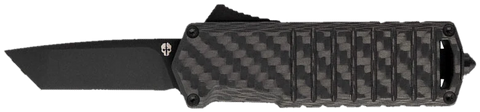
An out-the-front knife, or OTF, keeps its blade inside the handle on a straight track. A spring inside the handle drives the blade along that track, and small latches catch it at full extension and when it is fully home. The handle is a precisely machined tube, usually aluminum, because the track has to stay straight for the blade to run smoothly. What separates single action from double action is how the spring is loaded and what you have to do to close the knife. Our guide to what OTF means covers the basics, and our types of automatic knives guide puts the OTF beside the side-opener and the stiletto.
Single Action: Fire Out, Close by Hand
In a single-action OTF, the spring sits compressed and loaded behind the blade while the knife is closed. Pressing the button releases a latch, the spring drives the blade forward, and a lock catches it at full extension. Because the spring is still pushing forward against that lock, the blade is held hard in place, which is why single-action knives are known for solid lockup.
To close it, you release the lock and draw the blade back into the handle against the spring. Most single-action designs do this with a charging handle at the back of the knife that you pull rearward, which pulls the blade home and loads the spring again for the next shot. It takes two hands or a careful one-handed technique, and it takes a moment. Single-action OTFs tend to fire harder and faster than double-action ones, since the spring is fully loaded before you touch the button.
Double Action: One Slider, Both Ways
In a double-action OTF, the spring is connected to a slider on the face of the handle, the contoured button on a TEKTO. When the knife sits open or closed, the spring is relaxed. Push the slider forward and you stretch the spring until it passes a trip point, then it snaps the blade out of the front and the latches lock it. Pull the slider back and the same thing happens in reverse: the spring loads, trips and fires the blade back into the handle. Opening and closing are the same motion in opposite directions, done with one thumb, in either hand.
A well-made double action also protects itself. If the blade meets resistance on the way out, such as a pocket seam or a finger, it stops short instead of forcing through, and a second pull back and push forward resets it. Our OTF reset guide walks through what to do when that happens.
Lockup and Blade Play
This is single action's real advantage. With the spring pushing the blade forward against its lock, a single-action OTF can feel almost like a fixed blade when it is open. A double-action OTF holds its blade with latches at each end of the track, and the spring is relaxed once it fires, so a little side-to-side movement at the tip is normal. That small play is part of the design, needed so the blade can slide smoothly in its track, and it does not mean the knife is loose or weak. It has no effect on cutting. If the play ever gets worse over time, or the blade moves forward and back in the lock, that is a reason to have the knife looked at.
Speed and Force
Both mechanisms are fast. A single-action OTF fires with the full force of a spring that has been waiting, which some people love and others find startling. A double-action OTF fires briskly in both directions, and it fires back into the handle just as fast as it fires out, which a single action cannot do. In everyday use, the time that matters is not the opening shot but the full open, cut and close cycle, and double action wins that easily, since closing is a flick of the thumb instead of a pull on a charging handle.
Safety
An OTF blade leaves the handle quickly, so the first rule for both types is to know where the front of the knife is pointing before you press the button. Keep the tip clear of your other hand, your leg and anything you do not mean to cut, and never fire it into an object. A double-action OTF is the safer daily carry for two reasons. You close it with your thumb on the slider, far from the edge, and the spring sits relaxed in your pocket instead of loaded. Single-action knives store a loaded spring, so many add a safety or a recessed button, and closing them puts your second hand near the back of a live blade. Our knife handling safety guide covers the basics for every knife.
Maintenance and Misfires
Both types share the same enemy: lint, sand and grit in the track. A blade that fires short, sticks halfway or will not lock is almost always dirty or dry, not broken. Blow the track out with compressed air through the front opening with the blade closed and again with it open, wipe the blade, and add a single drop of light oil where the blade enters the handle, then cycle it a dozen times and wipe off what comes out. Do not flood it with oil, which collects more lint, and do not open the handle, since the spring and track are set to tight tolerances. Our OTF cleaning guide has the full routine.
Springs in a double-action OTF spend most of their lives relaxed, which is easy on them. Single-action springs sit compressed whenever the knife is closed and are built for it. Either way, a quality spring lasts many thousands of cycles. If yours ever fails, TEKTO knives are covered by the TEKTO lifetime warranty against defects in materials and workmanship.
What the Law Says
The law does not care which kind you carry. Federal law and most state laws define a switchblade by how it opens, a blade that springs open from the handle at the press of a button or other device, and single-action and double-action OTFs both fit that definition. Where automatics are legal, both are legal, and where they are restricted, both are restricted, usually with the same blade length limits. In California, for example, an automatic with a blade under 2 inches is legal to carry, which is why our A2 Badger and A5 Spry Mini have 1.85-inch blades. Check your state in our Knife Laws by State guide, and see our post on the Fifth Circuit's 2026 switchblade ruling for what it does and does not change at the federal level. This guide explains the law in general terms and is not legal advice.
Which One Should You Buy
If you carry an OTF every day and use it for boxes, tape, cord and the hundred small cuts a day brings, buy a double action. Every opening comes with a closing, and closing is where double action earns its keep. If you want the firmest possible lockup on an automatic and do not mind closing it with two hands, a single action is worth a look, and so is a side-opening automatic, which locks like a folder. If you are buying your first automatic, start with a small double action like the A2 Badger, which teaches the action at a size and price that suit a first knife, and read our OTF blade length guide before you choose a size.
Why TEKTO's OTFs Are Double Action
We build out-the-front knives to be carried every day and used dozens of times a day, and for that, double action is the better mechanism. You open and close it with one thumb, in either hand, without changing your grip, and the spring rests relaxed in your pocket. It resets itself safely if it meets resistance, and closing never puts your fingers near the edge. The small amount of blade play that comes with it never affects a cut. Every TEKTO OTF works this way: the A2 Badger, our best seller, the A5 Spry and A5 Spry Mini, and the A7 Zastava. If you want an automatic with the solid lockup of a folder, our side-opening A3 Delta is the other way to go, and our OTF vs side-opening guide compares the two. Our OTF buying guide helps you choose the size and steel.
TEKTO's Double-Action OTFs
Every TEKTO out-the-front knife opens and closes with one thumb, from the 1.85-inch Badger and Spry Mini to the full-size Spry and Zastava.
-
-
-


A5 Spry Mini
Regular price $179.99Regular priceUnit price per -

LOW ON STOCK


People Are Asking
What is the difference between a single-action and a double-action OTF?
A single-action OTF fires its blade out with a button and has to be closed by hand, usually with a charging handle at the back. A double-action OTF opens and closes with the same slider on the face of the handle: push forward to fire the blade out, pull back to fire it home.
Is single action or double action better?
For everyday carry, double action. It opens and closes with one thumb in either hand, the spring rests relaxed, and it resets safely if the blade meets resistance. Single action locks up more solidly and fires harder, which some collectors and specialists prefer.
Why does my double-action OTF have blade play?
A little side-to-side movement at the tip is normal for a double-action OTF, because the blade has to slide smoothly in its track and is held by latches rather than spring pressure once it fires. It does not affect cutting. Play that gets worse over time is a reason to have the knife checked.
Are TEKTO OTF knives single or double action?
Double action, every one of them: the A2 Badger, A5 Spry, A5 Spry Mini and A7 Zastava all open and close with the contoured button on the face of the handle.
Are double-action OTFs legal?
They are treated the same as any other automatic knife. Federal law and most state laws define a switchblade by how it opens, so single-action and double-action OTFs are legal or restricted together. Check your state in our Knife Laws by State guide.