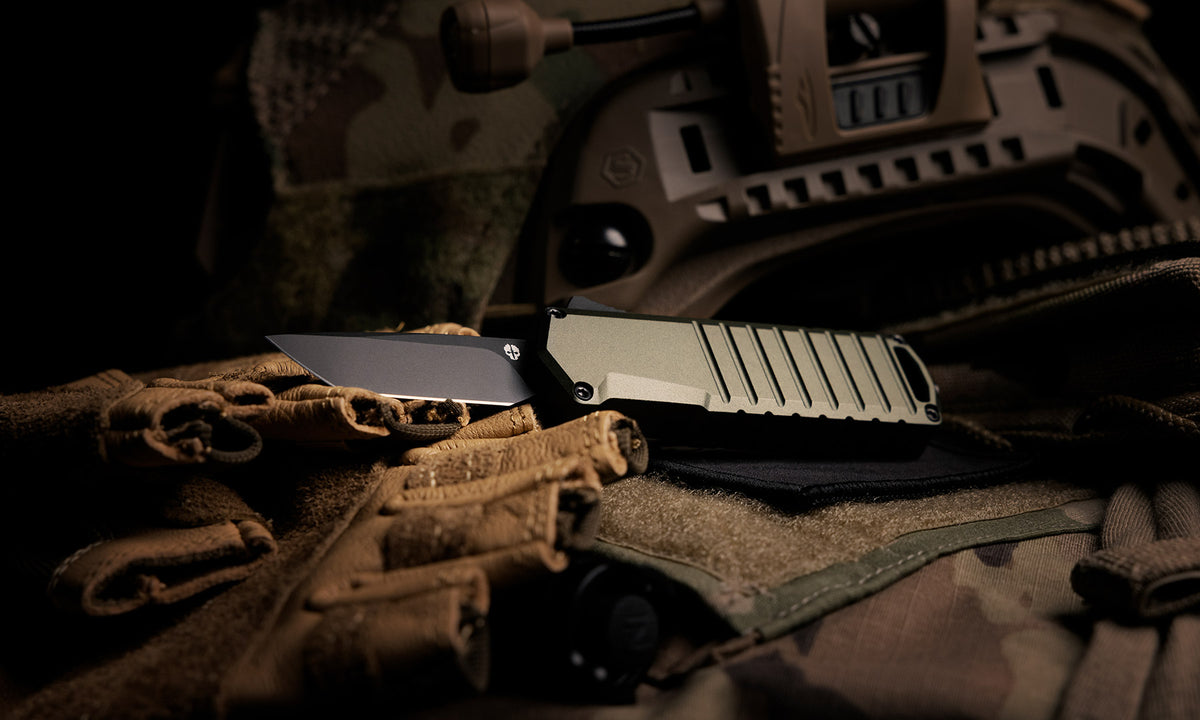
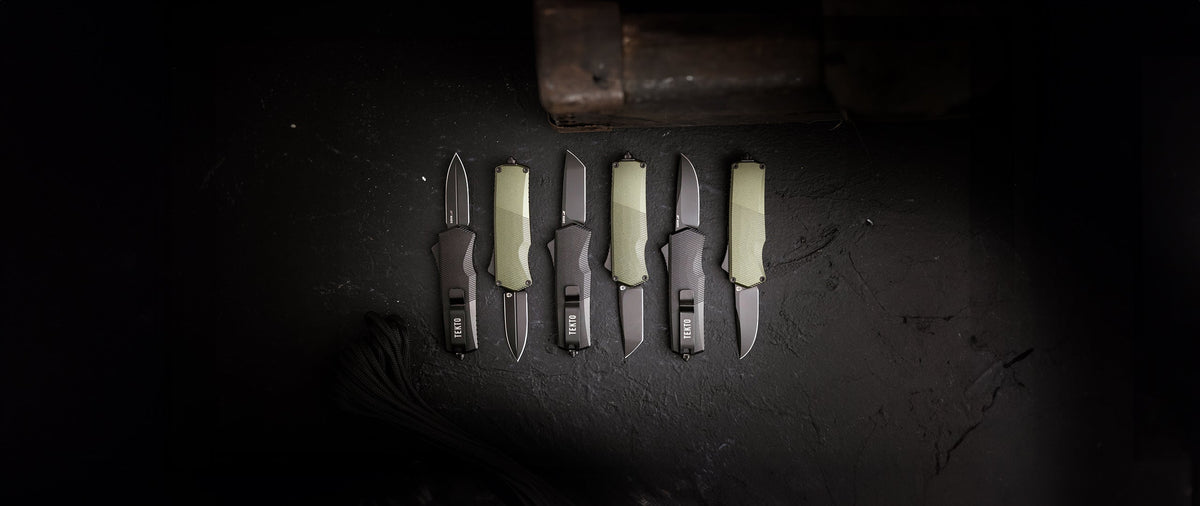
The Short Version
The A2 Badger and the A5 Spry Mini are the same size of knife: a double-action OTF with a 1.85-inch blade, an aluminum handle a hair over 3 inches, a weight within a few hundredths of an ounce of each other, a glass breaker and an ambidextrous clip. Both are under California's 2-inch line. What separates them is steel, blade shape and price. The Spry Mini runs S35VN, offers a Drop Point, and costs more. The Badger runs titanium-coated D2, comes in Tanto or Double Edge and four finishes, and costs less. If you want the best steel or a drop point, the Spry Mini. If you want the most knife for the money in the smallest package, the Badger. The rest of this page is the detail behind that sentence, with the prices pulled live from the store.
Side by Side
| A2 Badger | A5 Spry Mini | |
|---|---|---|
| Price | From $139.99 | From $179.99 |
| Action | Double-action OTF | Double-action OTF |
| Blade length | 1.85 in (47 mm) | 1.85 in (47 mm) |
| Steel | Titanium-coated D2, 58-60 HRC | S35VN, 60-62 HRC |
| Blade shapes | Tanto, Double Edge | Drop Point, Tanto, Double Edge |
| Handle | 3.25 in, 6061-T6 aluminum | 3.20 in, 6061-T6 aluminum |
| Open length | 5.28 in | 5.30 in |
| Weight | 2.18 oz (62 g) | 2.15 oz (61 g) |
| Glass breaker | Yes | Yes, tungsten |
| Lanyard hole | Yes, oversized for 550 cord | Yes |
| Pocket clip | Ambidextrous | Ambidextrous |
| Finishes | Black, Desert, OD Green, Carbon Fiber | Black, OD Green |
| California legal | Yes | Yes |
Steel: D2 Against S35VN
This is the real difference. D2 is a high-carbon tool steel that has been the working-knife standard for decades: it holds an edge well, takes a keen edge on any stone, and is tough enough for a small blade that gets used as a pry bar now and then. Its chromium content stops just short of stainless, which is why the Badger's blade wears a titanium coating and why the bare edge wants a wipe after wet work. S35VN is a powder-metallurgy stainless with vanadium and niobium carbides, hardened on the Spry Mini to 60 to 62 HRC. It holds an edge noticeably longer than D2, resists rust without a coating, and takes a bit more effort to sharpen because of it. For a knife that opens boxes and cuts cord, both steels go weeks between touch-ups. The Spry Mini goes longer, the Badger comes back faster on a stone. If you sharpen your own knives and do not mind doing it, D2 is no handicap. If you want to forget about the edge for as long as possible, S35VN is worth the difference. Our D2 guide goes deeper.
Blade Shapes
The Spry Mini offers three shapes and the Badger two, and the one the Badger lacks is the one most people want for everyday cutting. The Drop Point, Spry Mini only, carries a curved belly for slicing and a lowered, rounded tip that is less likely to catch, which makes it the all-rounder. The Tanto, on both, replaces the belly with a second straight edge meeting the main edge at an angle, which gives a thick, reinforced point for prying, scoring and piercing at the cost of some slicing curve. The Double Edge, on both, grinds both sides to a symmetrical spear point, the finest piercer and the one to check your state on, since a few states treat double-edged blades differently. So: drop point, Spry Mini. Tanto or double edge, either knife, and the choice comes down to steel and price.
Handle, Weight and Carry
In the hand they are twins. Both handles are 6061-T6 aluminum, contoured and textured for grip, within a twentieth of an inch of each other in length and within three hundredths of an ounce in weight. Both put a double-action slide on the centerline, a glass breaker at the base and an ambidextrous clip on the back, so both carry the same in either pocket and work the same in either hand. The small differences: the Spry Mini's glass breaker is tungsten. The Badger's lanyard hole is oversized to take full 550 paracord. The Badger offers four finishes, including Desert and a Carbon Fiber edition, where the Spry Mini offers Black and OD Green. If a particular look matters to you, that may settle it.
Price and What You Get for It
The Badger starts at $139.99 and the Spry Mini at $179.99, and the gap is the steel. You are paying for S35VN and the drop point, and for nothing else, because the size, action, clip and glass breaker are a wash. That makes the question simple. If you will sharpen the knife yourself and want to spend less, the Badger gives up nothing you will notice in daily use. If you want the longer-lasting edge and the drop point, the Spry Mini is the better knife and the price reflects it. Prices above are live from the store and change with sales.
Which One to Buy
The A5 Spry Mini if you want a drop point, the best steel, or the knife you will carry for years without thinking about the edge. The A2 Badger if you want a first OTF, a backup blade, a specific finish, or the most knife for the money. It is the one we would hand a first-time OTF buyer. Either one is California legal, works in either hand, and fits in a coin pocket. Our A2 Badger guide and A5 Spry Mini introduction cover each knife on its own.
The Two Contenders
Pick a blade shape and a finish. The size is the same either way.
-
-


A5 Spry Mini
Regular price $179.99Regular priceUnit price per


People Are Asking
Is the A5 Spry Mini better than the A2 Badger?
It has the better steel (S35VN against D2) and a Drop Point option, and it costs more. In size, action, clip and glass breaker the two are a wash. Better depends on whether you will pay for the steel.
Which is smaller, the Badger or the Spry Mini?
Neither by anything you would notice: the Badger is 3.25 inches closed and 2.18 ounces, the Spry Mini 3.20 inches and 2.15 ounces, with the same 1.85-inch blade.
Are both California legal?
Yes. Both blades measure 1.85 inches, under the 2-inch line in California Penal Code 17235, so neither is a switchblade under state law.
Does the A2 Badger come in a drop point?
No. The Badger comes in Tanto and Double Edge. The drop point is the Spry Mini's alone among the two.
Which holds an edge longer?
The Spry Mini. S35VN at 60 to 62 HRC holds an edge noticeably longer than D2 at 58 to 60. The Badger makes up for it by sharpening faster on an ordinary stone.
Which is easier to sharpen?
The Badger. D2 responds quickly to a stone or ceramic rod. S35VN takes a little longer because of its harder carbides. Both sharpen at about 20 degrees per side.
Do they share the same mechanism?
Both are double-action OTFs with a slide that fires and retracts the blade and a button lock that holds it at either end of its travel.