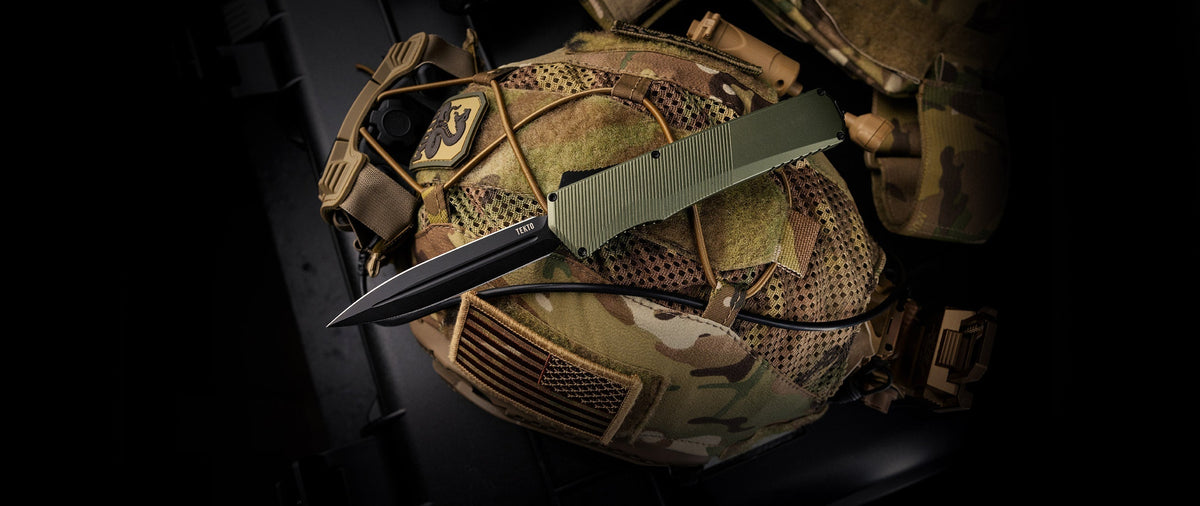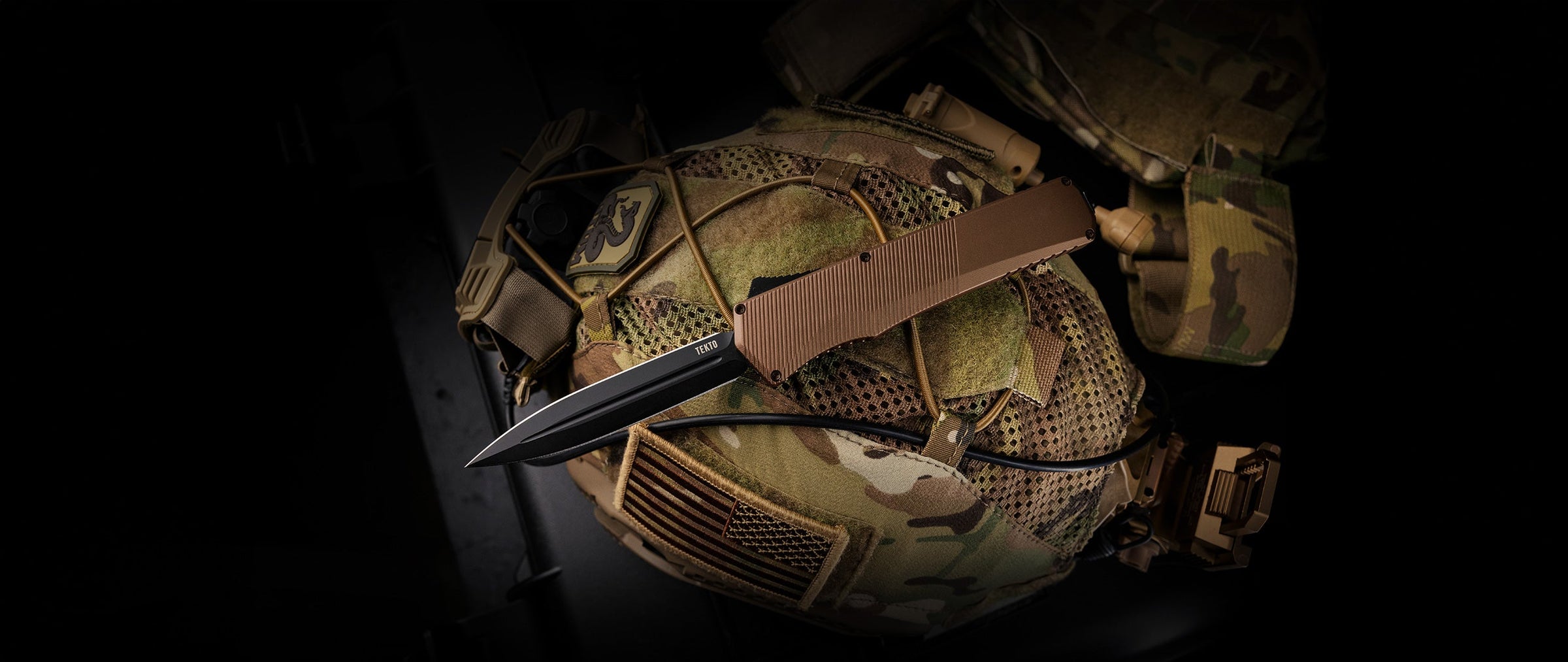
An OTF knife is an automatic knife whose blade travels straight out of the front of the handle and straight back in, driven by a spring and controlled by a thumb slider. OTF stands for out the front. That is the whole definition, and it is also where most of the confusion starts, because "OTF", "automatic" and "switchblade" get used as if they meant the same thing. They don't. This guide explains what an OTF knife is, how the mechanism works, how it differs from the other automatic knives, and what to look for when you buy one.
What is an OTF knife?
An OTF (out-the-front) knife keeps its blade inside the handle and deploys it in a straight line through an opening at the front. Push the slider forward and the blade comes out and locks. Pull it back and the blade retracts. Nothing swings, nothing pivots, and the blade never crosses your fingers on its way out.
The name only describes the direction the blade travels. It says nothing about the trigger, the spring or the steel, which is why two knives can both be called OTF and feel completely different in hand. What every OTF shares is the one-handed, straight-line action and a closed profile that looks like a plain handle until you use it.
OTF knives are not folding knives. A folder's blade pivots on a hinge and lies alongside the handle. An OTF's blade slides on rails inside it. That difference matters for how the knife locks, how it is cleaned, and in some states how it is regulated.
How does an OTF knife work?
Inside the handle, the blade rides on a carriage attached to a spring. The slider on the outside of the handle is connected to that carriage. As you push the slider forward, you are stretching the spring while a small latch holds the blade in place. Near the end of the slider's travel, the latch releases, the spring snaps the carriage forward, and the blade flies out until it hits the front stop and locks. Pulling the slider back does the same thing in reverse: load the spring, trip the latch, snap the blade home.
That is why an OTF has a distinct feel. The first part of the slider's travel is firm, because you are loading the spring, and then the blade goes on its own. It is also why a quality OTF needs real engineering: the carriage has to run true on its rails, the stops have to take thousands of impacts, and the springs have to keep their tension for years.
One behavior surprises new owners. If the blade meets resistance on the way out, say it catches on fabric in a pocket, it does not force its way through. It slips off the spring and stops part-way, loose in the handle. That is a safety feature. The fix takes two seconds: pull the blade fully out by hand until it clicks, and it is back on the spring. Our guide to resetting an OTF knife walks through it.
Single action or double action?
A double-action OTF opens and closes with the slider. A single-action OTF opens with a button but has to be closed by hand, usually by pulling a charging handle or pushing the blade back in against the spring.
Double action is what most people picture when they think of an OTF, and it is what every TEKTO OTF uses. It is the more convenient of the two and the safer to close, because your fingers stay on the slider rather than on the blade. Single-action knives have a simpler mechanism and often a harder-hitting deployment, and some collectors prefer them for that, but for daily use double action is the right default.
OTF, switchblade, automatic, side-opening: what is the difference?
"Switchblade" is the legal term, "automatic" is the industry term, and "OTF" describes the direction the blade travels. An OTF knife is one kind of automatic knife. Under most state laws it is also a switchblade, because the blade opens by spring when you press a button or slider.
| Type | How the blade moves | How it opens | Example |
|---|---|---|---|
| OTF automatic | Straight out of the front of the handle | Spring, released by a thumb slider | A2 Badger, A5 Spry, A7 Zastava |
| Side-opening automatic | Swings out from the side on a pivot, like a folder | Spring, released by a button | A3 Delta |
| Assisted-opening folder | Swings out from the side on a pivot | You start it with a thumb stud or flipper. A spring finishes the swing | Most modern pocket knives |
| Manual folder | Swings out from the side on a pivot | Thumb stud, flipper or nail nick, under your own power | F1 Alpha, F2 Bravo, F3 Charlie |
The side-opening automatic is the classic switchblade shape: a folder with a spring and a button. TEKTO makes both, which is the easiest way to feel the difference. The A3 Delta is a side-opener with a 3.60-inch blade that swings open at the press of a button. The A5 Spry is an OTF with a 3.50-inch blade that slides straight out. Same job, two different mechanisms, and in some states two different legal categories, which section 07 covers.
An assisted-opening folder is not an automatic knife at all. The spring only helps once you have started opening the blade yourself, and that distinction is written into most knife laws.
Who carries an OTF knife?
Anyone who needs a knife open in one hand without looking at it. First responders and nurses cut seatbelts, clothing and straps with the other hand busy. Electricians, warehouse crews and farmers open an OTF with gloves on, which is hard to do with a thumb stud. Hunters and anglers like that the blade comes out clean in cold or wet hands. And a lot of people simply carry one every day because it is the fastest, most satisfying knife to open and close, and because the closed profile slips into a pocket without a blade edge anywhere near the fabric.
What an OTF is not ideal for is batoning, prying or heavy chopping. The blade is held by the mechanism's stops rather than a frame lock, so it is a cutting tool, not a camp axe. For that work a fixed blade like the X1 Atlas is the right knife.
Blade shapes and steels on OTF knives
Because the blade travels through a slot, OTF blades are slimmer and straighter than most folder blades, and four shapes cover almost every OTF made:
- Double edge. Sharpened on both sides to a symmetrical point. The classic OTF profile, best for piercing and fine point work. In some states a double-edged blade is regulated separately, so check your state's guide before choosing it.
- Drop point. A single edge with a gently sloping spine. The most forgiving all-round shape for everyday cutting.
- Tanto. A single edge with an angled secondary point. A strong tip for piercing tough material. Our tanto guide covers when it is the right choice.
- Spear point. A single edge with a symmetrical profile, which gives a centered tip without the second edge.
Steel matters more on an OTF than on a folder, because the blade is thinner. TEKTO uses three: titanium-coated D2 on the A2 Badger, a hard tool steel that holds an edge well and relies on its coating against rust. S35VN on the A5 Spry, A5 Spry Mini and A7 Zastava, a stainless powder steel that balances edge life, toughness and corrosion resistance. MagnaCut on the A5 Spry Bronze Edition, the current benchmark for doing all three at once. The knife steel guide compares them in detail, and the MagnaCut guide explains why that steel is different.
Blade length and the law
OTF knives are legal to own in most of the United States, legal to carry in many states, and restricted in a minority of states and some cities. The rules turn on three things: whether automatic knives are allowed at all, how long the blade can be, and whether you carry it openly or concealed.
Blade length is the lever you control when you buy. California is the clearest example: automatic knives with blades under 2 inches are outside the state's switchblade law, which is why the A2 Badger and A5 Spry Mini (both 1.85 inches) are carried there every day. Several other states and cities also draw lines at 2, 2.5 or 3 inches.
This guide is not legal advice, and local ordinances can be stricter than state law. Our 50-state OTF knife law guide is checked against current statutes and links to a detailed guide for each state, including California, Texas, New York, Illinois, Florida and Massachusetts.
How to choose an OTF knife
Five decisions, in the order that matters:
- Blade length. Under 2 inches if you live in or travel through a 2-inch state, or want the smallest possible carry. Around 3.5 inches for a full-size everyday knife.
- Action. Double action unless you specifically want a single-action collector's piece. Try the slider: it should feel firm, then crisp, with no grinding.
- Blade shape. Drop point if you are not sure. Double edge if you want the classic look and your state allows it. Tanto if you cut a lot of tough material.
- Steel. D2 for value and edge life, S35VN for stainless performance, MagnaCut if you want the best and are willing to pay for it.
- The handle and the extras. Aluminum keeps the weight down. The A2 Badger is 2.18 ounces. Look for an ambidextrous pocket clip, a glass breaker if you drive a lot, and a warranty you can actually use.
Budget in round numbers: a well-made compact OTF starts around $140, a full-size S35VN model around $250, and premium-steel or collaboration editions run $275 to $300.
Caring for an OTF knife
An OTF needs less care than its mechanism suggests, and it never needs to be taken apart. Every few weeks, or after a dusty or wet day: blow out the handle with compressed air, blade extended, to clear lint and grit from the rails. Wipe the blade dry. Put one drop of light knife oil where the blade enters the handle, cycle it a few times, and wipe off the excess. Too much oil collects grit and slows the action.
If the blade ever stops part-way or goes slack, it has come off the spring: pull it fully out until it clicks and it is reset. If the action gets gritty or slow, clean before you reach for oil. The full cleaning guide and the OTF troubleshooting guide cover both in detail, and every TEKTO knife is covered by our warranty.
Knives in This Guide
The four TEKTO OTF knives this guide refers to, smallest first.
-
-


A5 Spry Mini
Regular price $179.99Regular priceUnit price per -
-


People Are Asking
What does OTF stand for?
Out the front. The blade deploys straight out of the front of the handle instead of swinging out from the side.
Is an OTF knife a switchblade?
Legally, usually yes. Most state laws define a switchblade as any knife whose blade opens automatically by spring when a button or slider is pressed, and an OTF does exactly that. "Switchblade" is the legal word, "automatic" is the industry word, and "OTF" describes the direction the blade travels.
How does an OTF knife work?
A spring-loaded carriage inside the handle carries the blade. Pushing the slider loads the spring and then trips a latch, and the spring snaps the blade out to its stop. Pulling the slider back does the same in reverse.
What is the difference between single-action and double-action OTF knives?
A double-action OTF opens and closes with the slider. A single-action OTF opens with a button and has to be pulled closed by hand. All TEKTO OTF knives are double action.
Are OTF knives legal?
In most states, yes, with limits on blade length or carry in some. California treats automatic knives with blades under 2 inches differently from longer ones. Check our 50-state guide and your city's rules before you carry.
Why did my OTF blade stop halfway?
The blade met resistance on its way out and slipped off the spring, which is a safety feature, not a fault. Pull the blade fully out by hand until it clicks and it is reset.
Are OTF knives safe to carry?
Yes. The blade sits inside the handle with no edge exposed, and the slider needs a deliberate push to fire. Carry it clipped in a pocket, keep lint out of the handle, and never test the action with a finger in front of the blade.
How long does an OTF knife last?
With occasional cleaning and a drop of oil, the mechanism lasts for years of daily use. TEKTO's warranty covers defects in materials and workmanship. See the warranty page for the terms.