

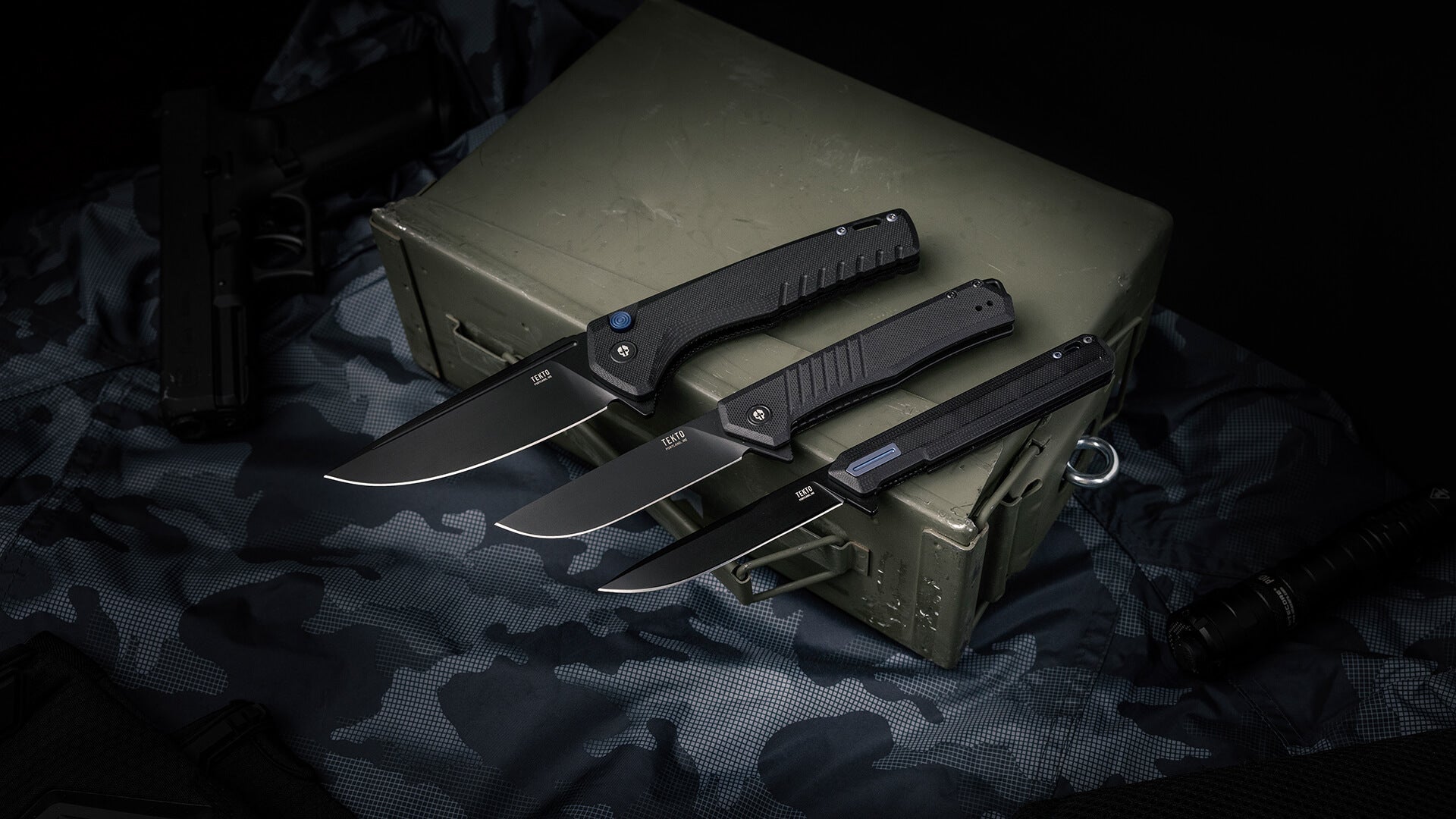
The Short Version
If the knife lives in a pocket and does a hundred small jobs a week, a folder. If it works outdoors, under load, in blood, mud or cold, a fixed blade. If you want the fastest one-hand knife and your state allows it, an automatic, which is a folder with a spring. Most people who use knives seriously carry a folder every day and keep a fixed blade for the days that need one.
The first version of this page listed advantages and disadvantages. This one explains where each comes from, because the trade-offs are not opinions. They follow from the hinge. A folder gives up some strength and some simplicity in exchange for a knife that is half its length when closed and safe in a pocket. A fixed blade gives up the pocket in exchange for a knife that has nothing to fail, nothing to clean out and nothing to open. Everything below is a consequence of that, including the law, which in a number of states treats the two differently. The folding knife anatomy guide and the hunting knife guide go deeper on each side.
What a Folding Knife Is, Mechanically
A folding knife is a blade pivoting on a pin inside a handle, held open by a lock and closed by the hand. Its strength is the strength of three parts: the pivot, which carries every sideways load. The lock, which carries every load that tries to close the blade. The handle, which holds both. A liner lock, as on the F1 Alpha and F2 Bravo, is a spring leaf cut from the handle liner that snaps behind the blade tang. A button lock, as on the F3 Charlie and F4 Echo, is a sprung plunger that drops into a notch in the tang and holds the blade open and closed. A frame lock is a liner lock made from the handle itself. A lockback is a rocker bar over the spine. All of them hold a blade for every cutting task a pocketknife is asked to do, and none of them should be asked to hold it against a twist or a pry, which is where folders break. Ceramic bearings in the pivot, which the F1 and F2 run on, make the action smooth and the flipper fast. They do not make the knife stronger, and they do ask for a cleaner pivot than a plain washer. The anatomy guide has a diagram of all of it.
What a Fixed Blade Is
A fixed blade is one piece of steel from point to butt with a handle attached to the back half. When the steel runs the full length and width of the handle, with the scales pinned or screwed to either side, it is full tang, which is what the X1 Atlas is. When the steel narrows to a rod or a stub inside the handle, it is a partial, stick or rat-tail tang, which is lighter and weaker. A full-tang fixed blade has no pivot to loosen, no lock to fail, no slot for grit to pack into and no moving part to freeze. Its only failure modes are a broken blade, which takes serious abuse, and a lost knife, which takes a bad sheath. The cost is that it is always its full length, and that length has to be carried in something, which is what the Kydex sheath on the Atlas is for. The grind matters more on a fixed blade than a folder because the knife is asked to do more: the Atlas is hollow ground for slicing and skinning, and a flat or saber grind is the choice for chopping and batoning.
Strength, and the Tasks That Need It
This is the clearest difference and the most misunderstood. For cutting, a good folder and a good fixed blade of the same steel and length are equally strong. The lock on a quality folder will hold any load a hand can put through a cut. The difference appears when the knife is loaded any way but along the edge. Batoning, driving the blade through a log with a stick, puts shock through the spine. Prying puts a bending load across the pivot. Chopping puts the whole mass of the swing into the lock. Digging, scraping and twisting put side loads on the pin. A full-tang fixed blade absorbs all of these. A folder, sooner or later, does not, and when a folder fails under a load like that, the blade closes on the hand that is holding it. The rule is simple: a folder cuts, and a fixed blade cuts and works. If your use includes splitting kindling, cleaning game, cutting rope under load, or any job where the knife is a tool as much as a blade, the fixed blade is the right one, and the survival uses guide describes most of those jobs.
Carry, Size and Weight
A folder is half its length closed, and a 3.3-inch blade in a 4.3-inch handle, which is the F2 Bravo, is a pocketknife anyone can carry anywhere a pocketknife is legal, at 2.4 ounces, on a clip, with nothing else required. A fixed blade with the same blade length, the Atlas, is 7.7 inches long all the time, weighs 3.88 ounces before its sheath, and has to ride on a belt, in a pack or around the neck. For most people on most days that settles it: the folder is the knife that is actually in the pocket. The fixed blade's carry advantages are real but situational. It is faster out of a sheath than any folder is out of a pocket, it needs no second motion to be ready, and it can be carried outside clothing where a folder's clip would print. The carry guide covers the clip, the belt and scout carry in detail.
| F2 Bravo (folder) | F3 Charlie (folder) | X1 Atlas (fixed) | A5 Spry (OTF) | |
|---|---|---|---|---|
| Blade | 3.30 in D2 drop point | 3.80 in D2 drop point | 3.30 in MagnaCut drop point | 3.50 in S35VN, three profiles |
| Length closed / overall | 4.30 in closed, 7.75 in open | 5.20 in closed, 9.12 in open | 7.70 in overall | 4.90 in closed, 8.60 in open |
| Weight | 2.4 oz | 4.5 oz | 3.88 oz plus sheath | 3.49 oz |
| Mechanism | Liner lock, flipper on bearings | Button lock, flipper | None, full tang | Double-action OTF, button lock |
| Carry | Pocket clip | Pocket clip | Kydex sheath, adjustable belt clip | Pocket clip |
| Best at | Daily carry, light work | Daily carry, harder work | Field, camp, hunting, hard work | One-hand daily carry where legal |
Maintenance and Reliability
A fixed blade is cleaned with a wipe and a drop of oil, and that is the whole of it. A folder has a pivot, a lock, bearings or washers and a slot that fill with lint, dust, sawdust, blood and sand, and all of them need to come out before they make the action gritty or the lock sticky. In a pocket in a city that is a monthly job. On a hunt or a job site it can be a daily one, and a folder that has dressed a deer wants a full wash and re-oil before it goes back in a pocket. Cold matters too: a folder's oil thickens and its lock stiffens below freezing, and a gloved hand does not work a flipper well, which is why the fixed blade is the winter knife and the hunting knife. An OTF is the folder's extreme case, since its whole mechanism lives inside the handle, and the OTF cleaning guide exists for that reason. None of this makes a folder unreliable. The F-series will run for years on a drop of oil and a blast of air. It makes the fixed blade the knife that is reliable when nobody is maintaining anything.
Speed and One-Hand Use
The fastest knife into the hand is a fixed blade in a good sheath: one motion, no mechanism, and the same every time. The folder is next, and the gap depends on the opener. A flipper on bearings, as on the F1 and F2, puts the blade open and locked in one squeeze. A thumb stud or hole takes a little longer. A two-hand slipjoint is slow by design. The automatic closes the gap entirely. An OTF like the A5 Spry fires with a slider under the thumb of the hand that is holding it, which is why one-hand knives for people whose other hand is busy, in a harness, on a ladder, holding a patient or a box, have been automatics since the paratroopers of 1940. The legal side of that is below. Closing is the other half of speed, and here the fixed blade loses a little, because sheathing a knife takes attention and both hands in a way that closing a folder or retracting an OTF does not.
The Law Treats Them Differently
In most states an ordinary folding knife may be carried in a pocket with no restriction, and the restrictions that exist fall on fixed blades, automatics, double edges and length. Fixed blades draw the most. California treats any fixed blade as a dirk or dagger, which may not be carried concealed at all. It must ride openly in a sheath on the belt, while a closed folder may go in the pocket. Texas restricts knives with blades over 5.5 inches from a list of places but otherwise leaves both alone. Colorado limits concealed carry of any knife over 3.5 inches. Massachusetts restricts dirks and daggers carried concealed. New York City caps the blade that may be carried in public at under four inches, and a few states have length caps of their own, which hit a fixed blade and a large folder alike. Automatics have their own map, and it is changing fast. The practical reading: a folder under 3.5 inches is legal in a pocket nearly everywhere. A fixed blade should be carried openly on the belt in any state you have not checked. The 50-state guide has the specific rules for every state, including the ones that treat the car as concealment.
Price, Steel and What You Get for the Money
A fixed blade is more steel and less machining, so at a given price it tends to carry a better blade. A folder is a mechanism, so at a given price more of the money goes into the pivot, the lock and the fit. That is why TEKTO's one fixed blade, the Atlas, runs MagnaCut, one of the best stainless steels available for a knife, and why the folders run D2 and S35VN, which are the right steels for a blade that is sharpened often and used in a pocket. The D2 guide and the MagnaCut guide explain the trade-offs. On either kind of knife, the thing to pay for is the steel and the lock, not the handle material, and the thing to avoid at any price is a folder with a lock that moves when you push on the spine, or a fixed blade with a tang you cannot see.
Which One, by What You Do
The real answer to "folder or fixed" is "for what," and the table says it faster than prose.
| Use | Choose | Why |
|---|---|---|
| Everyday carry, office and city | Folder (F2 Bravo, F1 Alpha) or small OTF where legal | Pocket size, legal nearly everywhere, a hundred small cuts a week |
| Job site and trades | Folder (F3 Charlie, F4 Echo) or OTF (A5 Spry) | One-hand opening with the other hand full. Harder use. Still a pocket knife |
| Camping and backpacking | Fixed blade (X1 Atlas) plus a folder | Food, wood, cord and camp chores want a full tang. The folder does the small work |
| Hunting | Fixed blade | Blood, cold and a knife inside an animal. Nothing to clean out of a pivot |
| Fishing | Fixed blade or a folder you can rinse | Wet hands, scales, a knife that is cleaned under a tap |
| Survival and bushcraft | Fixed blade, full tang | Batoning, feather sticks, shelter: the knife is a tool as much as a blade |
| One hand busy | Automatic, where legal | Fires and retracts under the thumb of the hand that holds it |
| A first knife | Folder with a solid lock | Learns the habits, fits every day, costs less to lose |
The Case for Both
Most people who use knives seriously stop choosing and carry two: a folder that is always in the pocket and a fixed blade that comes out for the days that need it. The folder does the daily work and the fixed blade does the hard work, and neither is asked to do the other's job, which is how a folder's lock stays tight and a fixed blade's edge stays sharp. For TEKTO that pairing is an F-series folder or an A-series OTF in the pocket and the X1 Atlas in the pack, and the everyday carry guide builds the kit around them. Pick the folder first, since you will carry it ten times as often, and pick the fixed blade for the one job you know you will ask of it.
One of Each, and the Automatic
The full-tang fixed blade, two folders at two sizes, and the OTF for the one-hand days.


People Are Asking
Is a fixed blade stronger than a folding knife?
For cutting, no. A good folder's lock holds any load a hand puts through a cut. For prying, batoning, chopping and twisting, yes, because a full-tang fixed blade has no pivot or lock to fail. A folder cuts. A fixed blade cuts and works.
Which is better for everyday carry?
A folder, almost always. It is half its length closed, rides on a clip, weighs a few ounces and is legal in a pocket nearly everywhere. A fixed blade is for the days that need one.
Which is better for hunting?
A fixed blade. Blood, cold and a knife working inside an animal are the worst conditions for a pivot and lock, and a full tang cleans with a wipe.
Are fixed blade knives legal to carry?
In most states, openly on the belt, yes. Concealed carry of a fixed blade is restricted in several states. California requires any fixed blade to be carried openly in a sheath. Check your state in the 50-state guide.
Is a folding knife safer than a fixed blade?
Closed in a pocket, yes. In use, a fixed blade is safer under hard loads because it cannot close on the hand. The dangerous moment for a folder is a lock that is not fully engaged.
What is a full tang?
A fixed blade whose steel runs the full length and width of the handle, with the scales attached to either side. It is the strongest construction. A partial or rat-tail tang narrows inside the handle and is lighter and weaker.
Are automatic knives folders or fixed blades?
Folders, with a spring. A side-opening automatic is a folding knife that opens itself. An OTF slides its blade out of the handle. Both are the fastest one-hand knives, and both are regulated as automatics.
Do I need both?
Most serious users end up with both: a folder for every day and a fixed blade for camp, hunting and hard work. Buy the folder first. You will carry it ten times as often.
What steel is best for a fixed blade?
A tough stainless powder steel if you can get it. The TEKTO X1 Atlas runs CPM MagnaCut, which combines high toughness with stainless corrosion resistance. The folders run D2 and S35VN.





