The Short Version
A hunting knife has one real job, which is turning an animal into meat in the field, and the knife that does it best is smaller than most people expect: a fixed blade of 3 to 4 inches, drop point, in a steel that holds an edge through a whole animal and does not rust from blood, with a handle you can grip wet and a sheath that keeps it on your belt. Everything bigger is a camp knife, and everything more specialized is a second knife you buy once you know you need it. TEKTO's hunting knife is the X1 Atlas, a 3.30-inch CPM MagnaCut drop point, full tang, made in the USA, with a Kydex sheath, and the F3 Charlie and F1 Alpha are the folders for the pocket and for birds. Below: fixed against folding, the blade shapes and what each is for, length, steel, handle and sheath, what field dressing actually asks of a knife, waterfowl, care after the hunt, and the kit.
Fixed or Folding
For dressing game, fixed. A fixed blade has no pivot to pack with blood, hair and fat, no lock to trust with a hand that is slippery to the wrist, and nothing to disassemble to clean. You rinse it, wipe it and put it back in the sheath. It is stronger at the one point a folder is weak, where blade meets handle, which matters when you lever a pelvis or split a sternum. The folder's case is the pocket: it rides closed and safe, weighs less, and is the knife you already have on you when a bird or a rabbit needs cleaning or a drag rope needs cutting. The sensible answer is both: a fixed blade in the pack or on the belt for the animal, and the folder you carry anyway for everything else. The X1 Atlas is the first. The F3 Charlie, with a 3.80-inch drop point and a button lock that keeps fingers clear when closing with cold hands, is the fullest-size second.
Blade Shapes for Game
The drop point is the hunting shape, and it is not close. The spine curves down to a lowered tip with steel behind it, so you can open a hide with the tip without punching the gut beneath it, and the long belly does the skinning and the joints. A skinner exaggerates the belly and blunts the tip, which is wonderful for long skinning strokes and useless for anything precise. A caper, or caping knife, is slim with a fine point for working around the face, ears and eyes of a trophy, which is the one place a drop point is too wide. A boning knife is a kitchen tool, long and flexible, for taking meat off the bone at home. A gut hook is a sharpened notch on the spine that opens the hide like a zipper without the tip touching the viscera. It is useful and it is a nuisance to sharpen, which is why many hunters skip it and learn to run the tip shallow instead. The clip point, the Bowie shape, has a fine fast tip that is also the easiest to snap in a joint. Our blade shapes guide covers the geometry. For hunting, buy the drop point and add a caper later if you mount heads.
Length and Thickness
Three to four inches. Inside a deer there is no room for more, and a longer blade is harder to steer around the organs you are trying not to cut. A 6-inch knife looks the part on a belt and gets in its own way at the one moment it matters. Three inches handles whitetail and antelope. Four is comfortable for elk and moose, where the hide is thicker and the cuts longer. The spine should be around an eighth of an inch, thick enough to pry a joint apart, thin enough that the blade still slices rather than wedges. The X1 Atlas runs a 3.30-inch blade on a 4.40-inch handle, 7.70 inches overall, 3.88 ounces: big enough for an elk, small enough that you do not feel it on your belt all day.
Steel for a Hunting Knife
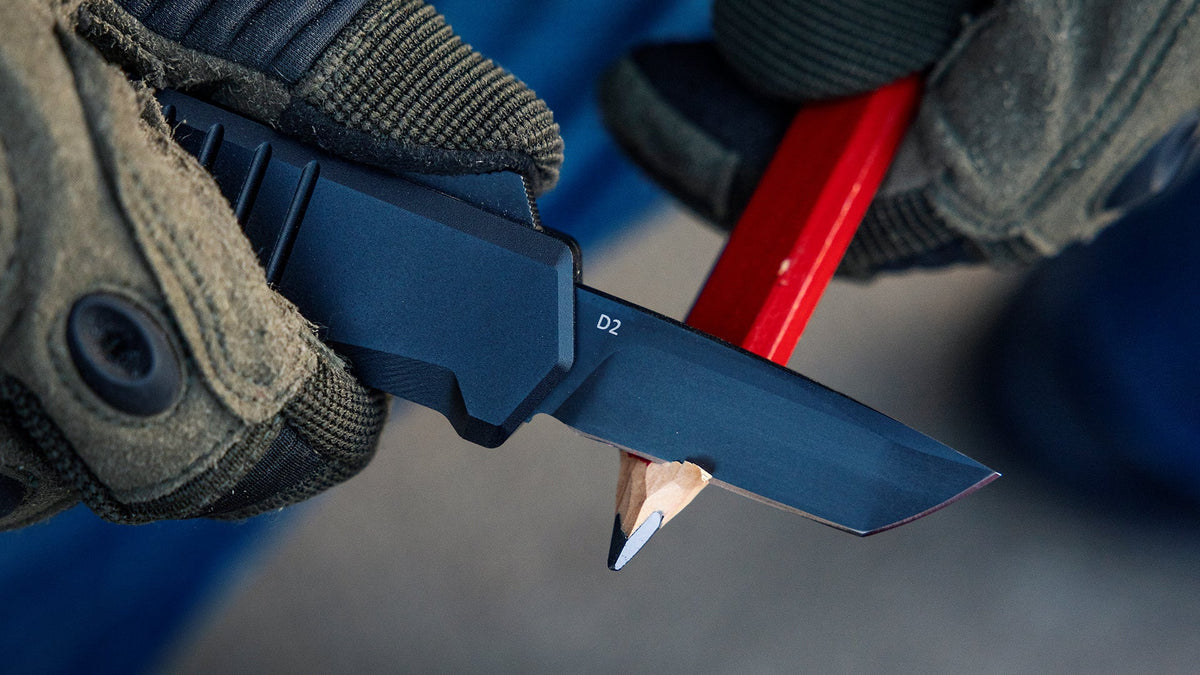
A hunting steel has to do three things that pull against each other: hold an edge through the whole animal (wear resistance), survive bone and frozen hide without chipping (toughness), and shrug off blood, which is salty and corrosive, for the hours before you can clean it (stain resistance). Most steels trade one for another. CPM MagnaCut, which the X1 Atlas carries at 60 to 62 HRC, is the first that does not have to: it holds an edge like a high-end stainless, takes abuse like a tool steel and resists rust better than either, which is why it has become the hunting steel of the last few years. Our MagnaCut guide explains why. D2, on the F3 Charlie and F1 Alpha, holds an edge well and sharpens quickly in the field, and it wears a titanium coating because it is not quite stainless, so it wants a wipe and a drop of oil after a bloody job. Our D2 guide has the detail. Whatever the steel, carry a small ceramic rod or a pocket stone. One animal will take the edge off any knife, and a hunting edge is about 20 degrees per side, which is what TEKTO ships.
Handle, Guard and Sheath
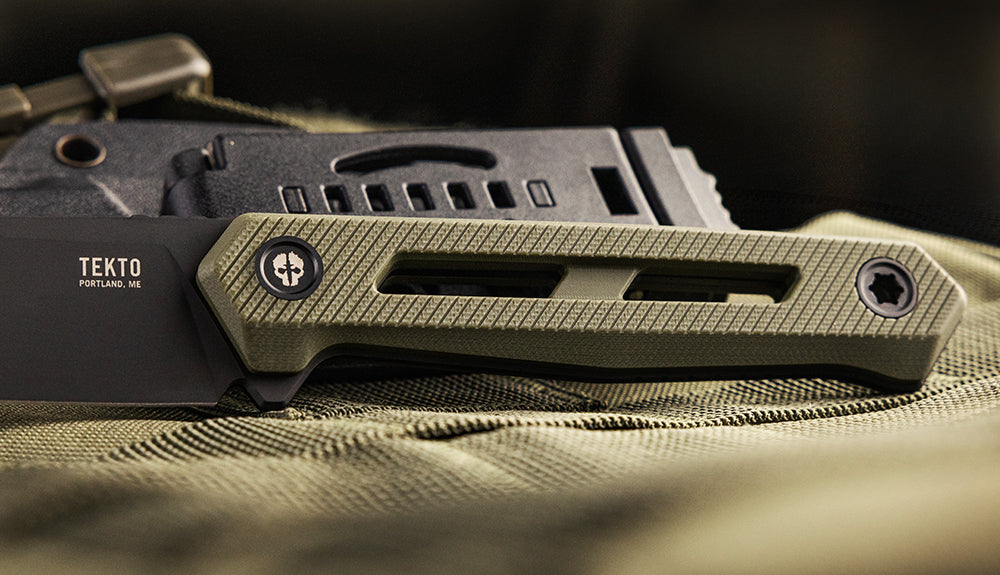
The handle will be wet, cold and bloody at the same time, so it needs texture rather than polish, a shape that fills the hand, and a guard or finger groove that stops the hand sliding forward onto the edge when a push cut gives way. G10 is the right material: it grips wet, does not swell or crack, and is light. A bright color is not vanity. A black knife set down in leaf litter at dusk is gone, which is a reason to pick the Desert or OD Green X1 Atlas over Black for the field. The sheath matters as much as the knife, because a hunting knife is carried for hours and used for minutes. Kydex is molded to the blade, clicks shut, sheds water and blood and rinses clean. Leather is handsome and holds moisture against the steel. The X1's Kydex sheath has an adjustable belt clip, so it rides where you want it, and a lanyard hole on the handle for a loop that keeps it attached to you over water or snow.
What Field Dressing Asks of a Knife
The job is a sequence of cuts, and each one tests a different part of the blade. The first cut opens the hide from the pelvis to the sternum: the tip goes in shallow, edge up, two fingers of the other hand under the skin lifting it off the gut, and the blade cuts out through hide only, which is why the lowered, controllable drop point tip matters and why a gut hook exists. The next cuts free the diaphragm and the windpipe, deep inside the chest, where blade length works against you and a clean point works for you. Then the pelvis: either worked around with the belly of the blade or split, which is the one moment the spine thickness and the full tang earn their keep, and the one job a folder should not be asked to do. Skinning is long strokes with the belly, edge angled into the hide, and it dulls a knife faster than anything else you will do all year. Quartering is joints, found with the tip and cut through with the belly. A knife never needs to chop bone. Caping, if you are mounting the head, is the caper's job, not this knife's.
Waterfowl and Small Game
Birds want a smaller knife than deer, and the job is different. Most duck and goose hunters breast the bird out: a cut down the keel, the breast meat peeled off each side with the tip and fingers, legs taken if the bird is worth it, and no gutting at all. That is a 3-inch job, and it is one a folder does well, because the knife lives in a pocket under waders and a blind coat and comes out wet. The things that matter are a blade that holds an edge through a limit of birds and a handle that grips with cold, wet hands. The F1 Alpha, a 3.10-inch titanium-coated D2 blade with a full flat grind on a G10 and carbon fiber handle, 3.03 ounces, is the TEKTO bird knife. Its glass breaker and ambidextrous clip are beside the point, its slicing edge is the point. Rinse it in the marsh if you can and dry it when you are home. The pivot of any folder collects feathers and blood. Rabbits, squirrels and upland birds are the same knife and the same rule: a short blade, a plain edge, and a wipe before it goes back in the pocket.
Care After the Hunt
Blood is the most corrosive thing a knife meets all year, and the damage is done in the hours between the field and the sink. Wipe the blade on grass or a rag as soon as the work is done, and if there is a stream, rinse it. At home, wash with warm water and dish soap, dry it completely, and put a drop of oil on the blade and, on a folder, into the pivot. Do not put a bloody knife away in a leather sheath. The leather holds the moisture against the steel. Touch the edge up on a ceramic rod or a fine stone at about 20 degrees per side and strop it, and it is ready for next season. A MagnaCut blade may need nothing more than the strop. Our sharpening guide and cleaning guide go through both.
The TEKTO Hunting Kit
One fixed blade for the animal and one folder for everything else, with a bird knife if you hunt waterfowl.
| X1 Atlas | F3 Charlie | F1 Alpha | |
|---|---|---|---|
| Role | The hunting knife: dressing, skinning, quartering | The full-size folder: camp, cord, small game | The bird knife: breasting ducks, upland, pocket carry |
| Type | Fixed blade, full tang | Manual flipper, button lock | Manual flipper, liner lock |
| Blade | 3.30 in drop point, hollow grind | 3.80 in drop point | 3.10 in modified straight back, full flat grind |
| Steel | CPM MagnaCut, 60-62 HRC | Titanium-coated D2, 60-62 HRC | Titanium-coated D2, 58-60 HRC |
| Handle | G10, 4.40 in. Black, OD Green or Desert | G10 and forged carbon, 5.20 in | G10 and carbon fiber, 4.50 in |
| Weight | 3.88 oz | 4.50 oz | 3.03 oz |
| Carry | Kydex sheath, adjustable belt clip, lanyard hole | Pocket clip, lanyard hole | Ambidextrous pocket clip, lanyard point |
| Made in | USA | ||
| Price | From $249.99 | From $129.99 | From $119.99 |
The Hunting Kit
The fixed blade for the animal, and the folders for the pocket.


People Are Asking
What is the best blade shape for a hunting knife?
The drop point. Its lowered tip opens a hide without puncturing the gut beneath, and its long belly does the skinning and the joints. Skinners, capers and gut hooks are specialists you add later, if ever.
Is a fixed blade or a folding knife better for hunting?
Fixed for dressing game: no pivot to foul with blood, nothing to disassemble to clean, and stronger where blade meets handle. A folder is the knife you have in your pocket for birds, small game and camp. Most hunters carry both.
What size hunting knife do I need?
Three to four inches of blade. Inside a deer there is no room for more, and a longer blade is harder to steer around the organs. Three inches handles whitetail. Four is comfortable for elk and moose.
What is the difference between a caping knife and a skinning knife?
A skinning knife has a deep belly and a blunt tip for long strokes between hide and meat. A caping knife is slim with a fine point for the detailed work around the face, ears and eyes of an animal that will be mounted. A drop point does most of both jobs.
What angle should a hunting knife be sharpened to?
About 20 degrees per side for a working edge that holds up to hide and bone. Some hunters go to 22 or 25 on a knife that will see heavy use. TEKTO ships its blades at about 20 per side.
Is MagnaCut good for a hunting knife?
It is the best all-round hunting steel available: edge retention close to a high-end stainless, toughness close to a tool steel, and better rust resistance than either, which matters with blood on the blade for hours. The X1 Atlas is CPM MagnaCut at 60 to 62 HRC.
What knife do I need for duck hunting?
A small folder with a plain edge, about 3 inches, that you can grip wet. Most waterfowl hunters breast the bird out rather than gut it, which is a short-blade job. The F1 Alpha is the TEKTO pick.
Are hunting knives legal to carry?
A fixed-blade hunting knife is legal to own everywhere and legal to carry openly in almost every state, with some states restricting concealed carry of fixed blades and most making an exception for hunting and fishing. Our state knife law guides have the specifics for where you hunt.