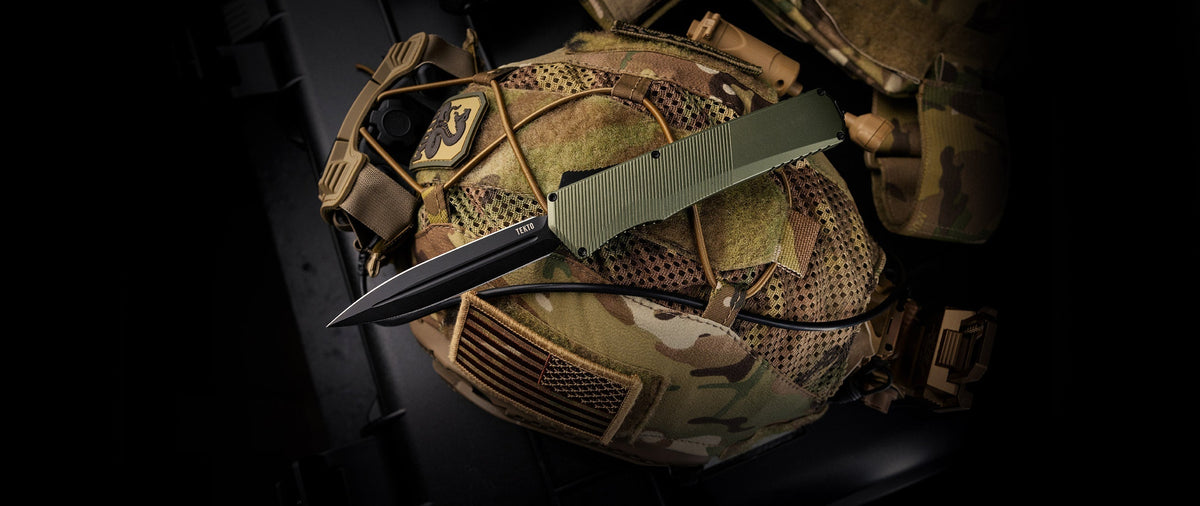
Choosing the right knife means matching the mechanism to the way you live. Automatic OTF knives give rapid, one-handed deployment for moments when time, grip or a free hand is short. Manual folding knives give control and discretion for daily utility work. The decision should follow function, not trend.
Start With How You Use a Knife
Before comparing mechanisms, blade styles or steels, be clear about the use. Most people do not need the best knife. They need the right knife. Ask yourself:
- Will the knife come out in a hurry, with one hand, when the other is busy?
- Is it a daily utility tool for work, travel or the outdoors?
- Do you value speed, or control and discretion?
- How often will you deploy it, and in what conditions?
An automatic OTF and a folding pocket knife solve different problems. Understanding which problem is yours is the whole decision.
Why Choose an Automatic OTF

Automatic OTF knives are built around one feature: instant deployment. Push a slider or press a button and the blade extends and locks. In an OTF the blade travels straight out the front of the handle rather than pivoting from the side.
That is more than a convenience. It is a design for the moments when time, grip or dexterity is limited, which is why OTFs are carried by first responders and by people who work with one hand full.
Why people choose an automatic:
- One-handed operation, even with gloves.
- Fast, repeatable deployment.
- Minimal hand movement under pressure.
- A straight blade path in use.
Modern automatics include internal safeties that prevent misfires and reduce wear. Kept clean, a good OTF is a reliable, precise tool, not the fragile novelty it is sometimes assumed to be. It does ask for awareness: dirt, lint and debris in the handle can affect deployment, so regular cleaning matters, and our OTF cleaning guide shows how. Automatics also carry legal considerations that vary by state and must be checked before you buy or carry.
Why Choose a Folding Knife

Folding knives are the most common everyday carry knives in the world, for good reason. A folder balances safety, simplicity and adaptability across countless daily situations.
The blade pivots into the handle and locks open in use. Deployment is manual or assisted, by thumb stud, flipper or opening hole. Slightly slower than an automatic, it gives the user deliberate control over the blade.
Why people choose a folder:
- Right for everyday cutting tasks.
- Easier to maintain over the long term.
- Legal almost everywhere and unremarkable in company.
- Slim, light and discreet.
For most people, the pocket knife comes out dozens of times a week, for boxes, rope, packaging, food and outdoor chores, and in those jobs precision matters more than speed. Folders also appeal to people who value mechanical simplicity: fewer internal parts, easy to clean, easy to service, and durable when built well.
Speed of Deployment
The biggest difference between the two is how fast they deploy. An automatic excels when every second counts: no pivot arc to manage, no grip adjustment, the blade is either in or out.
A folder introduces intention. You feel the blade open and you engage the lock, and for many people that feedback builds confidence and reduces accidental misuse in repetitive daily work.
The point is not that one is better. Speed and control serve different purposes: an automatic favors immediacy, a folder favors precision and predictability, and your environment decides which matters more.
Durability and Strength
Build quality decides durability more than the mechanism does. An OTF carries force along a straight blade path. A folder relies on the integrity of its pivot and lock. Both handle serious work when engineered properly, and both fail when abused beyond what they were made for.
Steel plays a large part. A quality blade steel gives strong edge retention, corrosion resistance and consistent performance over time. Judge durability by materials and construction, not by assumptions about the design.
Legality
Folding knives are legal for ordinary carry nearly everywhere. Automatics face stricter rules: some states ban them outright, others set blade length limits or concealed-carry conditions. As of our last check, Delaware, Hawaii, Minnesota, New Jersey, New Mexico, Washington and the District of Columbia prohibit automatic knives in most circumstances, and several others restrict them. Before buying an automatic, check the 50-state guide and your state's page. The best OTF is only useful if you can carry it legally.
Which One Fits Your Life
Choose an automatic OTF if you need fast, one-handed deployment and work in conditions where a free hand is rare, you are comfortable with routine maintenance, and your state allows them. Choose a folding knife if you want a reliable everyday utility tool, you value control and discretion, and your knife use is frequent but unhurried.
At TEKTO we build both, because different days ask for different tools. Whether you are drawn to the immediacy of an A5 Spry or the versatility of an F1 Alpha, the right choice is the one that earns its place in your pocket every day.
Two Automatics, Two Folders
The OTF and the side-opener on one side, the liner lock and the button lock on the other.


People Are Asking
Are automatic OTF knives better than folding knives for everyday carry?
Not better, better for specific situations. If you need fast, one-handed deployment when a hand is full or gloved, an OTF excels. For the everyday run of utility tasks, a folding knife is often the more practical, discreet and versatile choice.
Which is more reliable, an OTF or a folder?
Both, when well made and kept clean. A folder has fewer internal parts and is easier to maintain over years. An OTF relies on springs and a blade channel, so cleanliness and routine care matter more for consistent deployment.
Do OTF knives need more maintenance?
Yes. Debris inside the handle can affect deployment, so an OTF wants more frequent cleaning and a drop of oil. A folder is more forgiving and easier to service.
Are folding knives stronger than OTF knives?
Strength depends on build quality, materials and use more than on the mechanism. A folder relies on its lock and pivot. An OTF carries force along a straight blade path. Both handle real work within their limits, and neither likes prying.
How do I decide between an OTF and a folder?
By how you actually use a knife. If speed, one-handed access and readiness under pressure matter most, and your state allows automatics, choose the OTF. If the knife is a daily tool for frequent, controlled cutting, choose the folder.