The Short Version
A knife you will actually carry, a light that fits a pocket, a pen that writes on anything, a wallet that does not fold, and one thing that is not a knife to pry and turn with. Add a lanyard if your hands are wet or gloved, and a pocket sharpener so the knife stays a knife. Everything else is optional, and most of it is weight.
Everyday carry is the set of things you put in your pockets without thinking about it, and the test of each one is whether you reach for it in a normal week. The first version of this page paired three accessories with three knives. This one starts from the job each item does, says what to look for, names a few long-standing examples in each category, and matches a TEKTO knife to the kit you are building. The lights, pens and wallets named here are examples of long-standing products in each category. We sell knives and a lanyard, and nothing else on this list.
Start With the Knife
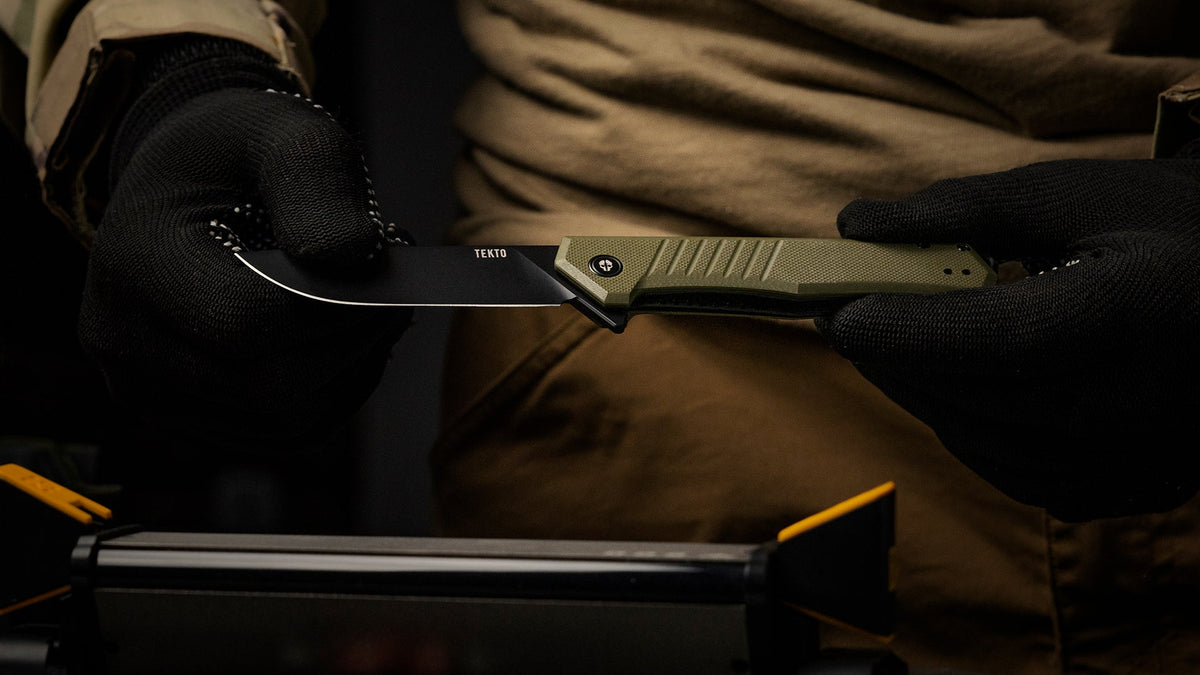
The knife is the anchor of the kit, and the right one is the one that disappears until you need it. For most people that is a folder between 3 and 3.5 inches that weighs under 4 ounces, opens with one hand, locks solidly, and rides on a deep pocket clip. The F1 Alpha, a 3.10-inch D2 drop point liner lock, is the simplest knife we make and the one to start with. The F2 Bravo at 3.30 inches adds a straight-back blade and handle options in forged carbon, titanium and G10. The F3 Charlie and F4 Echo are button locks at 3.80 and 3.40 inches, the Echo with a tanto. If your state allows automatics, the A5 Spry, a 3.50-inch S35VN OTF at 3.49 ounces, deploys and retracts with one thumb and never asks your other hand for help, which matters more than it sounds when the other hand is holding the box. The 1.85-inch A5 Spry Mini is the version for California and for anyone whose knife lives on a keychain. And if your days involve a truck, a trail or a campsite, the X1 Atlas, a 3.30-inch MagnaCut fixed blade in a Kydex sheath, is the knife that does not care about pocket lint or pivot screws. Pick one. The rest of the kit is built around it, and the folding knife anatomy guide explains what to look for if you are choosing between them.
A Light
A flashlight is the accessory people skip until the first time they need one, which is usually in a parking garage or under a sink. The one to carry is small enough to live in a pocket next to the knife: a single AA, AAA or 16340 cell, or a built-in cell with USB-C charging, in a body about the size of a marker. Look for a low mode under 10 lumens for reading a map or finding a keyhole without waking the house, a high mode of a few hundred lumens for everything else, a clip that holds it bezel-down in a pocket, and a tail switch or side switch you can find in the dark. Lumens beyond about 500 in a pocket light buy heat and short runtime, not usefulness. Rechargeable lights win on cost and output. AA lights win when you are far from a charger, because the gas station sells the battery. Long-running examples that fit the brief are the Streamlight Microstream, the Olight i3T and i5T, the Fenix E12 and the Acebeam Pokelit AA, any of which costs less than a tank of gas and lasts for years. Carry it on the opposite side from the knife so the two do not fight for the same pocket.
A Pen
A pen earns its place the day you have to sign a delivery, label a box in the cold or write on a cardboard flap in the rain. The qualities that matter are a metal body that survives a pocket full of keys, a refill that writes upside down, on glossy surfaces and in the wet, and a cap or click mechanism that does not open by itself. The pressurized cartridge in a Fisher Space Pen is the standard for the refill, and the Fisher Bullet is the classic pocket pen built around it. The Zebra F-701 is the inexpensive stainless click pen that takes the same style of refill with a small modification and costs a few dollars. Machined pens from the small makers who show at Blade Show are the step up, in brass, titanium or copper, at prices that start where a good knife starts. The old version of this page paired an inkless metal-tip pen with the F2 Bravo. They write faintly, forever, and are worth having in a bag, but for a pocket a pressurized ballpoint is the one you will use.
A Wallet for the Front Pocket
The back-pocket billfold is the one piece of traditional carry worth replacing, because it is the thickest thing most people own and sits under them for hours a day. A front-pocket wallet holds four to eight cards and a few folded bills in a slab a quarter inch thick, which leaves room for a knife in the same pocket and keeps both from printing. The choices are metal plates with an elastic band, the Ridge being the one everyone has seen, a minimalist leather or fabric sleeve, or a machined aluminum or carbon fiber frame like the Grid wallet the old page recommended. Two notes. RFID blocking, which most of them advertise, protects against a fairly rare attack on contactless cards and is not a reason to choose one over another. And a wallet with a money clip or a strap for cash is worth the small extra thickness, because the day you need cash is the day the card reader is down. Pair the wallet with a knife of similar heft: a forged carbon F1 Alpha or F2 Bravo next to a carbon fiber wallet is a pocket that weighs almost nothing.
Something That Is Not a Knife
The most common way to break a knife tip is to use it as a screwdriver or a pry bar, and the cheapest insurance against it is to carry the tool that does those jobs. A keychain pry bar, the Gerber Shard being the one most people own, opens paint cans, pulls staples, turns a flat screw and pops a battery cover, weighs under an ounce and costs less than lunch. A small multitool goes further: a Leatherman Skeletool or Squirt, a Victorinox Classic or Cadet, or any of the pocket-sized tools with pliers, a bit driver and a bottle opener. The point is not to replace the knife. A multitool blade is a backup, not a primary. The point is that when you reach for the knife, it is to cut something, and the knife stays a knife. If you carry one of our automatics, this matters doubly, because an OTF blade is a straight bar on a carriage and should never be levered sideways against anything.
Lanyard, Clip and Keys
Three small things change how the knife carries. A lanyard gives you something to find and grab in a deep pocket, with gloves on or with wet hands, and it keeps a fixed blade from leaving your hand on a wet day. The TEKTO paracord lanyard is 550 cord with a titanium bead, and the cord unravels into line for a boot repair or a tarp tie-down if you ever need it. A pocket clip decides where the knife sits and whether it prints. A deep-carry clip hides the knife below the pocket seam, a standard clip leaves a half inch showing for a faster draw. And a key organizer, the KeyBar or Orbitkey style that folds keys into a stack, stops the keys scratching the knife's scales and the light's lens, which is a bigger deal than it sounds once you own a forged carbon handle. If you want the knife to be unmistakably yours, blade engraving puts a name or a line on it before it ships.
Keep the Edge: The Maintenance Kit
A knife you carry every day gets dull every month or two, and an EDC kit that cannot restore an edge is incomplete. At home, a bench stone or a guided system. In the kit, a pocket sharpener. The Work Sharp Field Sharpener and the DMT Dia-Fold are the two most carried, both with a coarse diamond face for repair and a finer face for touch-up. A ceramic rod does the lightest touch-up of all. A strop, which can be the back of a leather belt, finishes the edge. Add a small bottle of pivot lubricant, a Torx driver for the pivot and clip screws, and a microfiber cloth, and the kit will keep a knife running for its whole life. Our sharpening guide walks through the 20-degree angle every TEKTO blade leaves the factory with, on a stone, a guided system and a rod, and the one tool we ask you not to use, the carbide pull-through, which scrapes steel off at a fixed angle and shortens the life of a good blade.
Three Kits
- The office pocket. A forged carbon F1 Alpha or A5 Spry Mini, a slim front-pocket wallet, a Fisher Bullet or a machined pen, a AAA light the size of a highlighter, keys in an organizer. Light enough that nothing prints, and the knife handles packages, tags and the occasional apple.
- The job site. An F3 Charlie or, where automatics are legal, an A5 Spry for one-handed opening with the other hand full. A pry bar on the keys so the tip never does that job. A Zebra F-701 that will write on a lumber stamp. A rechargeable light with a few hundred lumens and a clip. The TEKTO lanyard for gloved hands. A Work Sharp in the lunch bag.
- The trail and the truck. The X1 Atlas on the belt or in the pack lid, with a folder in the pocket as the second knife. A AA light because the gas station sells the battery. A multitool with pliers for the inevitable. The lanyard for the fixed blade. A DMT Dia-Fold. A pen, because the trailhead register and the permit both need one.
What to Leave Out
A few things sell well and carry badly. Credit-card knives are too thin to hold an edge and too awkward to open with one hand. A 1.85-inch OTF or a small slipjoint does the same job and does it well. Carbide pull-through sharpeners, for the reason above. Keychain gadgets that do nine things, none of them as well as the one-thing tool they replace. A second and third knife, unless one is a fixed blade for a different job. A knife you never draw is just weight. And the instinct to prepare for everything, which turns a pocket into a bag. The kit above weighs well under a pound and covers a normal week. The test of every addition is whether you used it last week, and if the answer is no for a month, it goes in the drawer.
The Anchor of the Kit
Two folders, the everyday OTF and the fixed blade: one for each kind of week.


People Are Asking
What should be in a basic everyday carry kit?
A knife, a pocket flashlight, a pen that writes on anything, a slim front-pocket wallet, and a pry bar or small multitool so the knife tip never gets used as one. A lanyard and a pocket sharpener round it out. Together they weigh well under a pound.
What is the best knife for everyday carry?
For most people a folder between 3 and 3.5 inches under 4 ounces with a solid lock and a pocket clip: the F1 Alpha or F2 Bravo. Where automatics are legal, the A5 Spry opens and closes with one thumb. For a truck, trail or campsite, the X1 Atlas fixed blade.
Do I need a flashlight if my phone has one?
A phone light is fine for finding a keyhole. It is not fine for a parking garage, a crawlspace, a roadside at night or anything that takes two hands, and it drains the thing you need to call for help. A pocket light the size of a marker fixes all of that.
Is an OTF knife a good everyday carry knife?
Yes, where it is legal. An OTF deploys and retracts with one thumb and never needs the other hand, which is the point when that hand is holding the box. The A5 Spry is the everyday size. The Spry Mini is the under-2-inch version. Check the 50-state guide first.
Do RFID-blocking wallets matter?
Not much. The attack they prevent, reading a contactless card through a pocket, is rare and limited. Choose a wallet for thickness, card count and whether it holds cash. Take RFID blocking if it comes along.
What is the TEKTO lanyard made of?
550 paracord with a titanium bead. It makes the knife easier to find and hold with gloves or wet hands, and the cord unravels into line for a field repair or a tie-down.
How do I keep an everyday carry knife sharp?
A pocket diamond sharpener such as the Work Sharp Field Sharpener or DMT Dia-Fold for touch-ups, a strop to finish, and a bench stone or guided system at home. Every TEKTO blade is ground at about 20 degrees per side. The sharpening guide shows the method. Skip carbide pull-through sharpeners.
Should I carry more than one knife?
Only if the second one does a different job, such as a fixed blade for camp work alongside a folder for the pocket. A second folder you never draw is weight, and a multitool blade is a better backup.