The Short Version
Washington is one of the last states that still bans automatic knives. RCW 9.41.250 makes it a gross misdemeanor to manufacture, sell, dispose of or possess a "spring blade knife," and the definition reaches gravity knives and anything that swings open with a flick. The same section bans furtively carrying a dagger, dirk or "other dangerous weapon" with intent to conceal, which is why fixed blades ride openly in Washington. Beyond that the state is quiet: no permit, no blade length, no rule against a folding knife in a pocket. The catch is local. Washington preempts city firearm laws but not city knife laws, so Seattle can and does ban carrying any fixed blade or any blade over 3.5 inches. Repeal bills for the automatic ban passed the Senate in 2024 and 2025 and died in the House both times, and the 2026 bill was shelved in the Senate and died when the session ended on March 12, 2026, so for now the ban stands.
The Spring Blade Knife Ban
RCW 9.41.250(2) defines the banned knife: "any knife, including a prototype, model, or other sample, with a blade that is automatically released by a spring mechanism or other mechanical device, or any knife having a blade which opens, or falls, or is ejected into position by the force of gravity, or by an outward, downward, or centrifugal thrust or movement." That is every side-opening automatic, every OTF, every gravity knife and, on the plain words, a butterfly knife, whose blade is swung into position by exactly the outward and centrifugal movement the definition names. No court has squarely decided the balisong question, and the definition's wording is a strong argument that it is covered, so treat one as banned in Washington.
The second sentence is the 2012 fix that keeps ordinary pocketknives legal: "A knife that contains a spring, detent, or other mechanism designed to create a bias toward closure of the blade and that requires physical exertion applied to the blade by hand, wrist, or arm to overcome the bias toward closure to assist in opening the knife is not a spring blade knife." A manual flipper with a detent, a thumb-stud folder and an assisted opener that you start by pushing on the blade all fit that sentence. The test is where the effort goes: if your hand works the blade against a bias toward closure, it is not a spring blade knife. If a button or switch on the handle does the work, it is.
The ban covers possession, not only sale, and it covers disposal, so handing an automatic to a friend or selling it online inside Washington is its own offense. RCW 9.41.251 exempts law enforcement officers, firefighters, rescue members, state patrol and military members on duty or moving the knife to and from storage, and lets manufacturers and distributors make and ship spring blade knives under contract or for evaluation. Nobody else is exempt. A gross misdemeanor under RCW 9A.20.021 carries up to 364 days in jail and a $5,000 fine.
Daggers, Dirks and Furtive Carry
The second offense in 9.41.250 is to "furtively" carry "with intent to conceal any dagger, dirk, pistol, or other dangerous weapon." The statute does not define "dangerous weapon," and the Washington Supreme Court filled the gap in State v. Myles (1995): a fixed-blade paring knife can be a dangerous weapon depending on the circumstances, "furtively" means stealthily or secretively, and intent to conceal can be proved from conduct and circumstances without any overt hiding motion. The practical reading, and the one AKTI gives, is that any fixed blade, whatever its length, can be charged as a dangerous weapon if it is carried out of sight in a way a court finds furtive.
So carry fixed blades openly: a sheath on the belt, visible, not under a jacket or in a waistband. A folding knife closed in a pocket is a different case. It is not a dagger or a dirk, and a pocket is where a pocketknife lives, so the ordinary tool carry the statute was never aimed at is not what prosecutors charge. The risk rises with the knife and the circumstances: a fixed-blade dagger tucked in a boot is the Myles fact pattern, and a double-edged blade is the textbook dagger. If you carry a fixed blade in Washington, let it be seen.
What You Can Carry
Outside the ban, Washington is permissive. Manual folding knives of any blade length, assisted openers with a bias toward closure, fixed blades carried openly, hunting and fishing knives, bowies, machetes and multi-tools are all legal to buy, own and carry statewide, with no permit and no state length limit. Double-edged blades are legal to own and to carry openly. Stilettos, disguised knives such as pen and belt buckle knives, and throwing stars are not on the state's banned list either, though throwing stars are barred from school facilities under 9.41.280. Open carry of a knife is never an offense by itself, though 9.41.270 applies to how you carry it (next section). Vehicles: the state has no knife rule for cars. A fixed blade in a sheath on the seat or in a bag is not "furtively" carried on your person, but a dagger shoved under the seat invites the question, so keep it in a case. Hunters, anglers and tradespeople have no special statute to rely on and do not need one, because open carry is already lawful. What they need to watch is Seattle.
Carrying in a Way That Alarms
RCW 9.41.270 makes it a gross misdemeanor to "carry, exhibit, display, or draw any firearm, dagger, sword, knife or other cutting or stabbing instrument, club, or any other weapon apparently capable of producing bodily harm, in a manner, under circumstances, and at a time and place that either manifests an intent to intimidate another or that warrants alarm for the safety of other persons." This is the statute behind most knife arrests that do not involve an automatic: flicking a knife open in an argument, holding one while shouting at someone, walking through a crowd with a drawn blade. The exceptions are your own home or fixed place of business, lawful self-defense against presently threatened force, on-duty officers and lawful arrests. A knife clipped to a pocket or worn in a sheath while you go about your day does not warrant alarm. A knife in your hand in a confrontation does. A conviction also costs you any concealed pistol license.
Seattle and Other City Rules
RCW 9.41.290 gives the state the whole field of firearm regulation and says nothing about knives, so cities write their own knife ordinances and Washington has no statute voiding them. Seattle's is the one that matters most. SMC 12A.14.010 defines a "dangerous knife" as "any fixed-blade knife and any other knife having a blade more than three and one-half inches" long, and a fixed-blade knife as "any knife, regardless of blade length, with a blade which is permanently open and does not fold," including "any dagger, sword, bayonet, bolo knife, hatchet, axe, straight-edged razor." SMC 12A.14.080 then makes it unlawful to "carry concealed or unconcealed on his or her person any dangerous knife." Inside Seattle, that is a ban on carrying any fixed blade at all and any folder over 3.5 inches, open or concealed. The exceptions in 12A.14.100 cover your home or place of business and a short list of activities such as lawful work, hunting and fishing. Read them before relying on one. The Washington Supreme Court upheld the ordinance against constitutional challenge in City of Seattle v. Montana (1996) and again in City of Seattle v. Evans (2015), where it held a small paring knife was not an "arm" the constitution protects.
AKTI reports that Tacoma and Vancouver have similar 3.5-inch rules. We have not read those codes ourselves, so check the city code before carrying a large folder or a fixed blade there. Spokane and most smaller cities follow state law. The habit that keeps you out of trouble in Washington is simple: a manual folder with a blade at or under 3.5 inches is legal in every city in the state.
Where You Cannot Carry
- SchoolsNo "dangerous weapon as defined in RCW 9.41.250" on public or private K-12 premises, school transportation or school-used facilities: a misdemeanor, a gross misdemeanor on a repeat, and grounds for expulsion. Spring blade knives, daggers, dirks and anything a court would call a dangerous weapon are covered, and every district's own rules ban the rest. Nonstudents 18 and over may keep a knife secured in an attended vehicle or locked out of sight in an unattended one while on legitimate business at the school.9.41.280
- Court areasNo "knife, dagger, dirk, or other similar weapon that is capable of causing death or bodily injury" in courtrooms, jury rooms, chambers, court offices, waiting areas and adjacent corridors: a gross misdemeanor. The county must provide a locked box or an official to hold it during your visit.9.41.300(1)(b)
- Jails, bars, airport secure areas, libraries, zoos, transit stationsThese places ban a "weapon," which 9.41.300 defines as a firearm, an explosive or an "instrument or weapon listed in RCW 9.41.250": spring blade knives, metal knuckles, slungshots, sand clubs and, by that section's wording, daggers and dirks. An ordinary folding knife is not on the list. Libraries, zoos and transit stations were added in June 2024.9.41.300(1), (17)
- Permitted demonstrationsNo open carry of a weapon, as defined above, at a permitted demonstration or within 250 feet of one after an officer tells you to leave.9.41.300(2)
- AirportsNo knives of any kind past the TSA checkpoint under federal rules.TSA
- Private propertyEmployers, venues and property owners set their own policy. Ignore a posted rule and you can be removed, and refusing to leave becomes trespass.Posted rules
Minors and Felons
State law sets no minimum age to own or carry a knife and no rule against selling one to a minor. The dangerous weapons statute applies to "every person" regardless of age, and the school statute is where a teenager's knife becomes a charge and an expulsion. Seattle goes further and restricts the sale to and possession of dangerous knives by people under 18 outside direct adult supervision. For a person with a felony conviction, Washington's unlawful possession statute, RCW 9.41.040, covers firearms only. Knife rules are the same as for anyone else, subject to any terms of community custody, which usually say more.
Penalties
| Offense | Section | Penalty |
|---|---|---|
| Manufacturing, selling, disposing of or possessing a spring blade knife | 9.41.250(1)(a) | Gross misdemeanor: up to 364 days, up to $5,000 |
| Furtively carrying a dagger, dirk or other dangerous weapon with intent to conceal | 9.41.250(1)(b) | Gross misdemeanor: up to 364 days, up to $5,000 |
| Possessing metal knuckles, a slungshot or a sand club | 9.41.250(1)(a) | Gross misdemeanor: up to 364 days, up to $5,000 |
| Carrying or displaying a knife in a manner that intimidates or warrants alarm | 9.41.270 | Gross misdemeanor. Loss of any concealed pistol license |
| A dangerous weapon on school premises | 9.41.280 | Misdemeanor: up to 90 days, up to $1,000. Gross misdemeanor on a repeat. Expulsion for students |
| A knife in a court area, or a listed weapon in a jail, bar, library, zoo or transit station | 9.41.300 | Gross misdemeanor: up to 364 days, up to $5,000 |
| Carrying a dangerous knife in Seattle | SMC 12A.14.080 | City weapons offense. The knife is seized |
The Repeal That Keeps Dying
Washington has come close to legalizing automatics three years in a row. In February 2024 the Senate passed SB 5860, a straight repeal of the spring blade ban, 45 to 3. The House never voted on it. In 2025 the Senate passed SB 5534, which would also have taken spring blade knives out of the school and courthouse statutes and treated them like any pocketknife. It died in the House, was reintroduced for the 2026 session, was moved to the Senate Rules "X" file on February 26, 2026 and was declared dead when the session ended on March 12, 2026. A House companion, HB 1962, never left committee. Until a bill clears both chambers and the governor signs it, the ban in 9.41.250 is the law. We will update this page the day that changes.
What the Internet Gets Wrong
Five things. First, that Washington legalized switchblades in 2012: the 2012 amendment added the bias-toward-closure sentence that protects assisted openers and the exemption for police, firefighters and the military, and nothing else. Second, that "any knife" is banned at bus stops and train platforms since 2024: the 2024 law added transit stations, libraries and zoos to RCW 9.41.300, whose definition of "weapon" for those places is a firearm, an explosive or a 9.41.250 instrument, not a pocketknife. Third, that there is a statewide 3.5-inch rule: that number is Seattle's, and it applies only inside Seattle and the cities that copied it. Fourth, that butterfly knives are plainly legal: the spring blade definition covers a blade that opens by "outward, downward, or centrifugal thrust or movement," which describes a balisong. Fifth, pages that quote California's Penal Code definition of a dirk or dagger as if it were Washington law. Washington's statute does not define either word, and our own earlier version of this page made that mistake.
TEKTO Knives for Washington
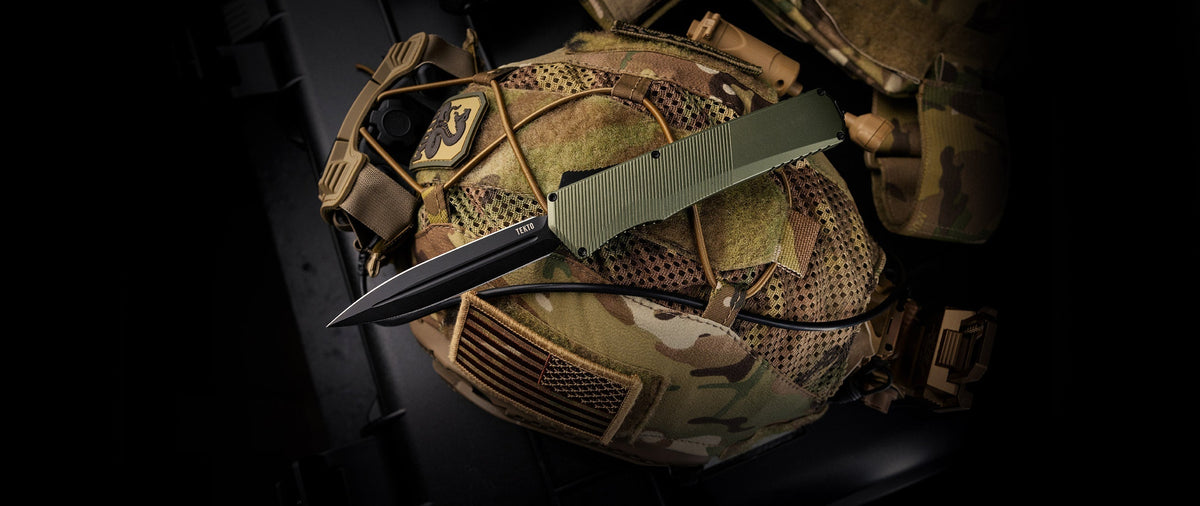
Our automatics stay out of Washington. The A5 Spry, A2 Badger, A7 Zastava, A4 and the side-opening A3 Delta are spring blade knives under RCW 9.41.250, illegal to possess anywhere in the state, and we will not pretend otherwise. What is legal is the manual line. The F1 Alpha (3.10-inch blade), F2 Bravo (3.30) and F4 Echo (3.40) are manual flippers: a detent or button lock holds the blade closed until your finger pushes the flipper tab, which is the sentence in 9.41.250(2) that says they are not spring blade knives, and all three are at or under 3.5 inches, so they are legal in Seattle and in every other city in the state. The F3 Charlie, the same kind of manual flipper with a 3.80-inch blade, is legal statewide and over Seattle's line. The X1 Atlas fixed blade is legal to own and to carry openly in a sheath anywhere Seattle's ordinance does not reach, and belongs in a pack, not on a belt, inside the city.
TEKTO Knives for Washington
The manual line. Three flippers under Seattle's 3.5-inch line, and a fixed blade for open carry.


People Are Asking
Are switchblades legal in Washington?
No. RCW 9.41.250 makes it a gross misdemeanor to manufacture, sell, dispose of or possess a spring blade knife, which covers every automatic. Only on-duty law enforcement, fire, rescue, state patrol and military personnel, and manufacturers and distributors working under contract, are exempt.
Can I own an automatic knife in Washington State?
No. Possession is part of the ban, not only sale. Repeal bills passed the Senate in 2024 and 2025 and died in the House, and the 2026 bill never left the Senate. The ban is still the law.
Are OTF knives legal in Washington?
No. An OTF is a spring blade knife under RCW 9.41.250(2), a blade "automatically released by a spring mechanism or other mechanical device."
What size knife can I carry in Washington State?
State law sets no blade length. Seattle bans carrying any fixed blade and any other knife with a blade over 3.5 inches, open or concealed, and AKTI reports Tacoma and Vancouver have similar rules. A folder at or under 3.5 inches is legal in every city in the state.
Are assisted-opening knives legal in Washington?
Yes, since the 2012 amendment. A knife with a spring or detent that biases the blade closed and that you open by pushing on the blade with your hand is expressly "not a spring blade knife" under RCW 9.41.250(2).
Are butterfly knives legal in Washington?
Treat them as banned. The spring blade definition covers any knife whose blade "opens, or falls, or is ejected into position by the force of gravity, or by an outward, downward, or centrifugal thrust or movement," which describes how a balisong opens. No appellate court has settled it.
Can you conceal carry a knife in Washington?
A folding knife in a pocket, yes. The state has no rule against it. A dagger, dirk or other fixed blade, no: furtively carrying one with intent to conceal is a gross misdemeanor under RCW 9.41.250(1)(b), and State v. Myles (1995) held a small paring knife can qualify. Carry fixed blades in a visible sheath.
Is Washington a knife preemption state?
No. RCW 9.41.290 preempts local firearm laws only, so cities write their own knife rules. Seattle is the main one: no fixed blades and no folders over 3.5 inches carried in the city.
Can I carry a knife on the bus or light rail in Washington?
A pocketknife, yes. The 2024 amendment to RCW 9.41.300 added transit stations, libraries and zoos to the restricted list, but the "weapon" banned there is a firearm, an explosive or a 9.41.250 instrument such as a spring blade knife, metal knuckles, a dagger or a dirk, not an ordinary folding knife.
What is the penalty for a switchblade in Washington?
A gross misdemeanor: up to 364 days in jail and a $5,000 fine under RCW 9A.20.021, plus forfeiture of the knife.
Sources
- RCW 9.41.250 Dangerous weapons: the spring blade knife and metal knuckles ban in (1)(a), furtive carry in (1)(b), the spring blade knife definition and bias-toward-closure exception in (2), as amended 2012 c 179
- RCW 9.41.251 Exemptions for law enforcement, fire, rescue and military personnel and for manufacturers and distributors
- RCW 9.41.270 Weapons apparently capable of producing bodily harm, unlawful carrying or handling
- RCW 9.41.280 Possessing dangerous weapons on school facilities
- RCW 9.41.300 Weapons prohibited in certain places, as amended 2024 c 285 (libraries, zoos, transit stations)
- RCW 9.41.290 State preemption, firearms only
- RCW 9A.20.021 Maximum sentences: gross misdemeanor 364 days and $5,000; misdemeanor 90 days and $1,000
- Seattle Municipal Code 12A.14 Weapons control: 12A.14.010 definitions, 12A.14.080 unlawful use of weapons, 12A.14.100 exemptions
- SB 5534 (2025-26) Concerning spring blade knives, Washington Legislature bill history
- AKTI Washington knife law summary, including State v. Myles (Wash. 1995) and the Seattle, Tacoma and Vancouver ordinances
- City of Seattle v. Evans Washington Supreme Court, December 31, 2015
Checked against the Revised Code of Washington on October 11, 2026. This page summarizes the law for general information and is not legal advice. Laws change, cities differ and enforcement varies by officer, prosecutor and judge; for your own situation, talk to a Washington attorney.
How these pages are researched: our method, sources and what we will not claim. Pending cases and recent changes are tracked on Knife Law Watch.